Tools › Orbital Mechanics › Space Environment › Orbital Heating and Eclipse › Method
Orbital Heating and Eclipse: Method
Open the Orbital Heating and Eclipse tool
Beta Angle, Eclipse, the Three Heat Loads, What It Assumes, Common Mistakes
What the tool does
It works out how much heat falls on each of the six faces of a box-shaped spacecraft as it goes around a circular orbit, and how long the spacecraft spends in the planet's shadow. From that it gives the heat each face absorbs on average over an orbit, the temperature at which each face and the whole box would settle, and the hottest and coldest days of the year for that orbit.
The idea
In orbit there is no air, so heat arrives only as radiation, from three sources (Figure 1):
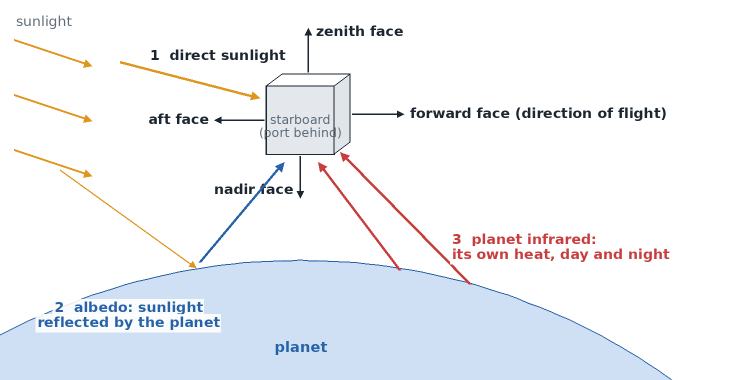
- Direct sunlight. About 1,367 W/m² near Earth on a surface that faces the Sun squarely, less on a tilted surface (by the cosine of the tilt), nothing on a surface turned away, and nothing at all in the planet's shadow.
- Albedo. Sunlight that the planet reflects back to space. It is strongest over the middle of the daylit side and absent over the night side. Only faces that can see the planet receive it.
- Planet infrared. The planet's own heat radiation, roughly the same day and night. Again only faces that see the planet receive it.
The box is held nadir-pointing: one face always toward the planet (nadir), one away from it (zenith), one in the direction of flight (forward), one behind (aft), and two sideways: port, which faces along the orbit normal (the direction of the orbit's angular momentum, written +h), and starboard, which faces the other way. As the box goes around, each face turns toward and away from the Sun once per orbit, and that is what the main figure of the results shows.
One angle controls almost everything: the beta angle β, the angle of the Sun above the orbit plane. At β = 0 the Sun lies in the orbit plane: the spacecraft passes straight behind the planet and the eclipse is as long as it can be. As β grows the orbit tilts out of the shadow; above a critical value there is no eclipse at all, and at β = 90° the orbit rides the day-night line with one side face lit all the time.
The equations
Rb is the radius of the planet, h the altitude, r = Rb + h the orbit radius, θ the orbit angle measured from orbit noon (the point of the orbit closest to the Sun) in the direction of flight, S the solar flux, a the albedo and qIR the planet infrared flux.
Period. T = 2π √(r3 / μ), with μ the gravitational parameter of the planet.
Beta from the date. The unit vector to the Sun s comes from low-precision almanac formulas (ecliptic longitude L and obliquity e of date), and the normal of the orbit plane n from the inclination i and the right ascension of the ascending node Ω:
s = (cos L, cos e sin L, sin e sin L), n = (sin Ω sin i, −cos Ω sin i, cos i), sin β = s · n
If the node is given as a local time, Ω = αmean Sun + 15° (LTAN − 12 h), where αmean Sun is the right ascension of the mean Sun. Through the year the node drifts because the planet is slightly flattened (J2):
dΩ/dt = −(3/2) J2 √(μ / r3) (Rb / r)2 cos i
The beta angle can never exceed the inclination plus the tilt of the planet's equator to its orbit around the Sun (23.44° for Earth).
Eclipse. The shadow is treated as a cylinder with the planet's radius. There is an eclipse only when |β| is below the critical angle β*, and it covers the orbit angles within θh of orbit midnight:
β* = asin(Rb / r), sin θh = √[(Rb / r)2 − sin2 β] / cos β, fraction in eclipse = θh / 180°
View factors. The share of a face's outlook that the planet fills, for the nadir face and for each of the four side faces (the zenith face sees no planet):
Fpar = (Rb / r)2, Fperp = (1 / π) [asin(Rb / r) − (Rb / r) √(1 − (Rb / r)2)]
The second is the paper's equation 8 rewritten in a shorter, identical form. At 408 km above Earth they are 0.883 and 0.287.
Flux on each face at orbit angle θ. Outside the eclipse the direct sunlight on a face is S times the cosine of the angle between the face and the Sun, when that is positive:
zenith: S cos β cos θ nadir: −S cos β cos θ forward: −S cos β sin θ aft: S cos β sin θ port: S sin β starboard: −S sin β
Albedo and planet infrared on a face with view factor F:
qalbedo = a S F cos β cos θ over the day side (zero where cos θ is negative), qinfrared = qIR F
Orbit averages. Integrating around the orbit gives closed forms:
zenith: S cos β / π
nadir: S cos β (1 − sin θh) / π
forward and aft: S cos β (1 + cos θh) / (2π)
the side face toward the Sun: S |sin β| (1 − θh / 180°); the other side face: 0
albedo: a S F cos β / π planet infrared: qIR F
With no eclipse θh = 0.
Absorbed power and equilibrium temperature. A face of area A with solar absorptivity α and infrared emissivity ε absorbs Q = A [α (qsolar + qalbedo) + ε qinfrared]. A body that radiates away what it absorbs settles at
T = [(Σ Q + Qinternal) / (σ Σ ε A)]1/4, σ = 5.670374 × 10⁻⁸ W/m²K⁴
The tool gives this for the whole box as one body at one temperature, and for each face alone as if its back were insulated.
Where it comes from and how it was checked
The method is that of S. L. Rickman of the NASA Johnson Space Center (2002). His test case, a 1 ft cube with α = ε = 1 at 220 nautical miles with a solar flux of 443.7 Btu/hr-ft², albedo 0.3 and planet infrared 77.0 Btu/hr-ft², is one of the "Try this" cases: the tool returns the paper's closed-form column (581.7 Btu/hr at β = 0°, 787.9 at 71°, 600.1 at 90°) to the printed digit at all eight beta angles, and the paper shows that column within 1.2% of a Monte Carlo ray-tracing solution. Three of the paper's printed equations contain misprints (a factor that belongs under a square root, a sign, and an angle that should be 180° minus the printed one); the forms above are the ones that reproduce its table and its starting integrals.
The environment cases on the form are from Rickman's 2014 NASA lesson: solar flux 1,367 W/m² at 1 au, 1,322 at aphelion and 1,414 at perihelion; albedo and planet infrared pairs for 90-minute averages in high-inclination orbits. The Sun formulas were compared with the JPL Horizons system for 2026 and 2035 and differ by less than 0.01°.
What it assumes
- A circular orbit and a box that stays nadir-pointing with its faces in the six principal directions.
- A cylindrical shadow with a sharp edge: no penumbra. In low orbit the penumbra lasts seconds.
- The planet radiates infrared equally from every point, and reflects sunlight with one albedo everywhere.
- The albedo flux on a face is its planet view factor times the brightness of the ground directly under the spacecraft. This is good in low orbit, where the spacecraft sees a small patch of the planet.
- Each face sees space and the planet only: no shadowing by, or reflection from, other parts of the spacecraft.
- The solar flux, albedo and planet infrared stay at the entered values through the year; the Sun's position is taken at 12:00 Universal Time each day.
When it misleads
- High orbits. The albedo model was made for low orbits. At geostationary height the albedo and planet infrared together are under one percent of the load on a box, so the totals remain useful, but the albedo number itself is rough. The eclipse and the two view factors hold at any height.
- High beta. Near the day-night line the single-cosine albedo is at its worst; the paper estimates about 10% error in the albedo term there.
- Thin, light surfaces. The temperatures are orbit-average equilibrium values. A solar panel or a foil blanket follows the instant flux instead and swings far above and below them; a heavy box stays near them. A real temperature needs a thermal model with heat capacity and conduction.
- Design cases. A hot or cold design case combines the worst beta with the worst solar flux, albedo, planet infrared, surface aging and internal power, and adds margins. The tool computes loads for the numbers entered; it does not choose them.
- Other attitudes. A Sun-pointing or inertially fixed spacecraft has a different history on every face. Only the nadir-pointing attitude is built in.
- Other planets by date. The date-to-Sun step is for Earth. For another body enter β directly, with that body's radius, gravitational parameter, solar flux, albedo and infrared.
Common mistakes
- Taking β = 0 as the hot case. At β = 0 the eclipse is longest, so for most boxes it is the cold end. The absorbed heat usually peaks where the eclipse has just vanished (about 70° in a 400 km orbit).
- Confusing β with the inclination. The inclination is the tilt of the orbit to the equator and stays fixed; β is the tilt of the Sun to the orbit plane and changes daily as the node drifts and the Sun moves.
- Forgetting the node drift. A 51.6° low orbit swings through its whole beta range in about two months because the node moves 5° a day. Holding the node fixed gives a slow yearly wave instead.
- Using the absorptivity for the planet infrared. Sunlight and albedo are absorbed in proportion to the solar absorptivity α; the planet infrared in proportion to the infrared emissivity ε.
- Applying albedo over the night side, or applying the full view factor to a side face: a side face sees about a third as much planet as the nadir face.
- Mixing flux units. 1 Btu/hr-ft² is 3.155 W/m²; the paper's 443.7 Btu/hr-ft² is 1,400 W/m².
Related tools
The orbit itself (elements, period, J2 drift rates, ground track) is in Orbital Elements and State Vectors. The heat loads found here are the inputs of a thermal model: Thermal Network Solver takes a heat load at each node, and Radiation View Factors gives the exchange between the surfaces of the spacecraft that this tool leaves out.