Tools › Civil and Geotechnical › Soils › Sieve Analysis and Soil Classification › Method
Sieve Analysis and Soil Classification: Method
Open the Sieve Analysis and Soil Classification tool
Sieve Analysis and Soil Classification: From Sieve Masses to a Soil Name
The tool takes the dry mass retained on each sieve of a stack and the liquid and plastic limits of a soil, and returns the gradation curve, the sizes D10, D30 and D60, the coefficients of uniformity and curvature, and the soil's class in the two systems used in the United States: the Unified Soil Classification System and the AASHTO system. Every decision that leads to the class is written out, so the page can be checked line by line against the flow charts.
The idea: two questions about a soil
Both systems ask the same two questions. How big are the grains? A stack of sieves answers that for everything coarser than 0.075 mm (the No. 200 sieve): the soil is shaken through the stack, each sieve is weighed, and the share that passes each opening is plotted against the opening on a logarithmic scale. How do the fines behave with water? Grains finer than 0.075 mm cannot be told apart by sieving, and what matters about them is whether they are sticky (clay) or not (silt). Two simple tests on the soil passing the No. 40 sieve answer that: the liquid limit LL, the water content at which the soil starts to flow, and the plastic limit PL, the water content at which it stops being moldable and crumbles. Their difference is the plasticity index PI.
The equations
Percent passing. For each sieve, with Mt the total dry mass of the sample and Mc the mass retained on that sieve and on all coarser ones:
percent passing = 100 × (Mt − Mc) / Mt
The pan and any fines washed out before sieving do not enter this formula; they are used to check that the masses add up to the total. When the fine sieves were run on a small split of the material passing one sieve (a common practice with gravelly samples), each of their results is multiplied by the percent passing the split sieve: percent of total passing = (percent passing the split sieve / dry mass of the split specimen) × mass passing.
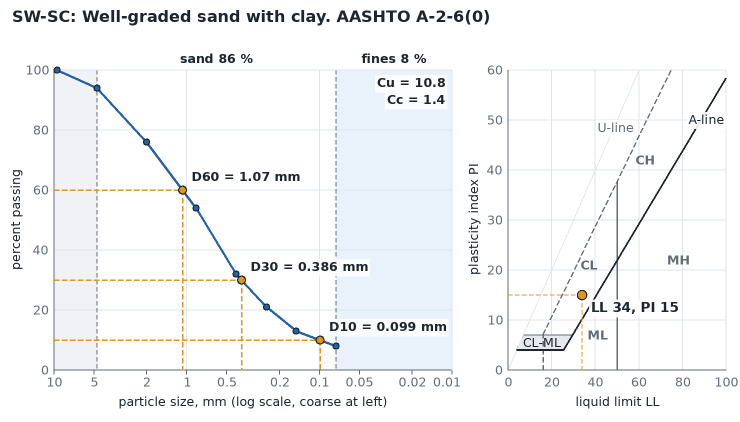
D sizes. Dx is the grain size at which x % of the sample is finer. Between two measured points (Dfine, Pfine) and (Dcoarse, Pcoarse) the curve is taken as a straight line on the logarithmic size scale:
Dx = Dfine × (Dcoarse / Dfine)t, t = (x − Pfine) / (Pcoarse − Pfine)
Gradation coefficients. Cu = D60 / D10 measures how wide the range of sizes is; Cc = D30² / (D10 × D60) measures whether the middle of the curve is where a smooth curve would put it. A gravel is well graded when Cu ≥ 4 and 1 ≤ Cc ≤ 3; a sand when Cu ≥ 6 and 1 ≤ Cc ≤ 3.
Fractions (Unified system). Gravel is what passes the 3 in sieve and stays on the No. 4 (4.75 mm); sand passes the No. 4 and stays on the No. 200 (0.075 mm); fines pass the No. 200.
Liquid limit from the test. Each trial gives a number of blows N and a water content w. The flow curve is the straight line of w against log10 N; the liquid limit is its value at N = 25. The tool fits the line by least squares. With a single trial it uses the one-point formula LL = w × (N / 25)0.120. The plastic limit is the average of its trial water contents, and PI = LL − PL, with both limits taken as whole numbers.
Plasticity chart. The A-line, PI = 0.73 × (LL − 20) (level at PI = 4 below LL = 25.5), separates clays (on or above) from silts (below). The U-line, PI = 0.9 × (LL − 8) (vertical at LL = 16 up to PI = 7), is about the upper limit for natural soils: a point above it is usually a test error.
The Unified system, step by step
- Fines 50 % or more: fine-grained. Below LL = 50: lean clay CL when PI > 7 and on or above the A-line; silty clay CL-ML when PI is 4 to 7 and on or above the A-line; silt ML otherwise. At LL = 50 or more: fat clay CH on or above the A-line, elastic silt MH below it. An organic soil (liquid limit after oven drying less than 75 % of the value before) is OL or OH. With 15 to 29 % coarser than the No. 200 sieve the name adds "with sand" or "with gravel"; with 30 % or more it begins "sandy" or "gravelly".
- Fines under 50 %: coarse-grained. Gravel (G) when there is more gravel than sand, otherwise sand (S).
- Fines under 5 %: GW, GP, SW or SP by Cu and Cc.
- Fines over 12 %: GM or SM when the fines are silt, GC or SC when they are clay, GC-GM or SC-SM when they plot in the CL-ML zone.
- Fines 5 to 12 %: a dual symbol, the gradation symbol first and the fines symbol second, such as SP-SM or GW-GC.
- The name adds "with sand" to a gravel that holds 15 % sand or more, and "with gravel" to a sand that holds 15 % gravel or more.
When a result lies close to a boundary, the Bureau of Reclamation procedure allows a borderline symbol with a slash, the classified group first (CL/CH). It gives no number for "close"; the tool reports a neighbor within 1 percentage point, a band you can change in Advanced mode.
The AASHTO system
The AASHTO table uses the percent passing the No. 10, No. 40 and No. 200 sieves, the liquid limit and the plasticity index. With 35 % or less passing the No. 200 sieve the soil is granular (A-1-a, A-1-b, A-3, A-2-4 to A-2-7); with more it is a silt-clay material (A-4 to A-7). The groups are tried from left to right and the first one whose limits all hold is the class. A-7 splits into A-7-5 (PI ≤ LL − 30) and A-7-6 (PI > LL − 30). The group index follows, with F the percent passing the No. 200 sieve:
GI = (F − 35) × [0.2 + 0.005 × (LL − 40)] + 0.01 × (F − 15) × (PI − 10)
It is rounded to a whole number, a negative value is taken as zero, groups A-1-a, A-1-b, A-3, A-2-4 and A-2-5 always have zero, and A-2-6 and A-2-7 use the second term alone. It is written in parentheses after the group: A-7-6(37).
Where the rules come from
The Unified rules are those of USBR 5000 in the Bureau of Reclamation Earth Manual, Part 2, the government laboratory procedure that parallels ASTM D2487, with the flow charts as the Federal Highway Administration prints them in Soils and Foundations (FHWA NHI-06-088). The AASHTO table and group index are taken from the same FHWA manual. The gradation and limit calculations follow USBR 5325, 5335, 5350, 5355 and 5360. ASTM D2487, D6913 and D4318 and AASHTO M 145 are cited, not reproduced. Sieve openings: FHWA NHI-06-088 Table 2-3 and USBR 5000; the 2 in, 1 in and 1/2 in sieves are listed at 50, 25.0 and 12.5 mm from memory of ASTM E 11.
What it assumes
- The sample is oven-dry, representative, and large enough for its largest particle.
- Between two sieves the curve is a straight line on the logarithmic size scale. Closely spaced sieves make this harmless; three sieves do not.
- Material coarser than 3 in is set aside and the classification is made on the rest, as the system requires.
- The Unified percentages are used as computed, the AASHTO table is entered with whole percentages, and the limits are whole numbers in both.
- A soil entered as non-plastic has silt fines (ML) and counts as non-plastic in the AASHTO table.
When it misleads
- A gap above D60. Cu and Cc see the curve only up to 60 % passing. A mix of coarse gravel and fine sand can pass both tests and still lack every size in between. Look at the curve.
- Too few sieves. With a wide gap between sieves the interpolated D sizes can be far off, and with them the well-graded or poorly graded call.
- D10 below the last sieve. When more than 10 % passes the No. 200 sieve, D10 is extrapolated (and flagged) unless hydrometer points are entered. The extrapolated value is an estimate.
- Dry sieving a soil with clay. Clay coats and binds the grains; without washing, the fines are undercounted and the soil looks coarser and cleaner than it is.
- Results on a boundary. One percentage point of fines, or one point of liquid limit, can change the symbol. The borderline note tells you when that is the case; the symbol alone does not.
- The class is not a design value. It groups soils that tend to behave alike. Strength, compressibility and permeability still have to be measured.
Common mistakes
- Dividing the mass retained by the sum of the sieve masses instead of the total dry mass taken before washing. The washed fines then vanish from the result.
- Using the mass retained on one sieve where the cumulative mass is needed: percent passing uses everything retained on that sieve and above it.
- Reading D10 as "10 % retained". D10 is the size with 10 % finer, near the bottom of the curve.
- Interpolating a D size on an arithmetic scale. Between 0.075 mm and 0.425 mm, halfway in percent is 0.18 mm on the logarithmic scale, not 0.25 mm.
- Calling a soil well graded on Cu alone. Both conditions must hold, and the limit for Cu is 4 for a gravel but 6 for a sand.
- Choosing gravel or sand by comparing each with 50 % of the whole sample. The comparison is between the two: more gravel than sand makes a gravel.
- Forgetting the dual symbol between 5 and 12 % fines, or writing SM-SC for fines in the CL-ML zone (the symbol is SC-SM).
- Using the A-line equation below LL = 25.5, where the line is level at PI = 4, and forgetting that PI from 4 to 7 above it is CL-ML, not CL.
- Mixing the two systems' sand: AASHTO splits gravel from sand at the No. 10 sieve (2 mm), the Unified system at the No. 4 (4.75 mm).
- Applying the full group index formula to an A-2-6 or A-2-7 soil, or reporting a negative group index.
- Drawing the flow curve on arithmetic paper: the number of blows goes on the logarithmic axis.