Tools › Finance and Business › Tax › Charitable Giving Floor and Bunching › Method
Charitable Giving Floor and Bunching: Method
Open the Charitable Giving Floor and Bunching tool
Charitable Giving Floor and Bunching: How It Works
What it does
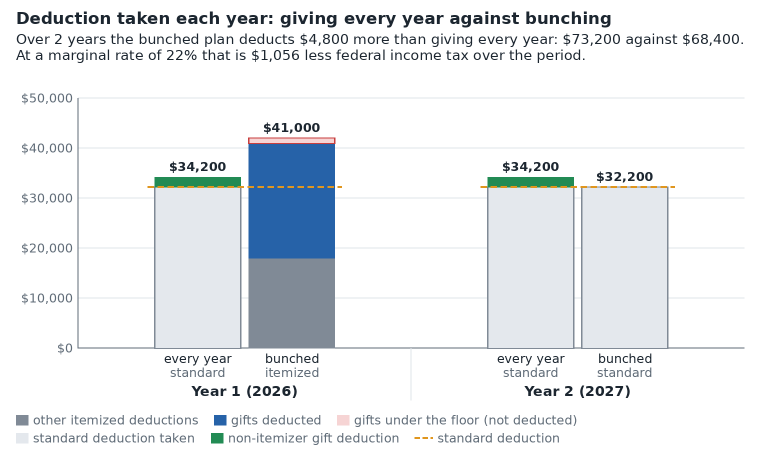
The page takes one household and one stream of cash gifts to charity and computes the federal deduction twice over 2 to 5 years: once with the gifts made every year, and once with the same gifts bunched into fewer years. It uses the rules that begin with tax year 2026 and shows each year, the totals and the difference in tax at the marginal rate you enter. It describes the two plans and does not say which to choose. It is an illustration, not tax advice.
The idea
Each year a taxpayer subtracts either the standard deduction or the total of the itemized deductions, whichever is larger. Gifts to charity are an itemized deduction, so in a year where the itemized total stays under the standard deduction the gifts change little. Three rules that start in 2026 change the arithmetic: an itemizer loses the first 0.5% of income of gifts in every year that itemizes; a taxpayer who takes the standard deduction may still deduct a small amount of cash gifts; and in the top bracket every itemized deduction is trimmed. Moving gifts between years changes how often each rule bites.
The three rules from tax year 2026
| Rule | What the law says | Where it was read |
|---|---|---|
| Floor for itemizers | A charitable contribution is allowed only to the extent that the total of the year's contributions exceeds 0.5 percent of the contribution base, which is adjusted gross income. | Internal Revenue Code section 170(b)(1)(I), added by Public Law 119-21, section 70425; Publication 505 for 2026, Worksheet 2-5 |
| Deduction for non-itemizers | A taxpayer who does not itemize deducts cash gifts to public charities up to 1,000 (2,000 on a joint return), with no floor. Gifts to supporting organizations and gifts that set up or maintain a donor-advised fund do not count. | Section 170(p) as amended by Public Law 119-21, sections 70424 and 70425(a)(3); Form 1040 for 2026 (draft), line 12f; IRS news release IR-2026-135 |
| Top-bracket reduction | Itemized deductions are reduced by 2/37 of the lesser of (1) the itemized deductions or (2) taxable income, with the itemized deductions added back, above the amount where the 37 percent bracket begins. It is applied after every other limit. | Section 68 as amended by Public Law 119-21, section 70111; Publication 505 for 2026, Worksheet 2-6 |
| Cash limit | Cash gifts to public charities are deductible up to 60 percent of adjusted gross income; the excess carries forward. | Section 170(b)(1)(G) as amended by Public Law 119-21, section 70425(b) |
One year, step by step
With adjusted gross income A, cash gifts G, other itemized deductions O and standard deduction S:
Floor F = 0.005 × A. Deductible gifts D = G − F, and zero when the gifts do not exceed the floor.
Itemized deductions I = O + D.
Top-bracket test: X = A − Q − T, where Q is the qualified business income deduction plus the Schedule 1-A deductions and T is the taxable income at which the 37% rate begins. When X is above zero, the reduction is R = (2/37) × the lesser of I and X, and the itemized deductions allowed are I − R.
Without itemizing: U = S + N, where N is the cash gifts up to the non-itemizer limit.
The deduction taken is the larger of the itemized deductions allowed and U.
The page repeats these steps for every year of both plans, adds the deductions taken, and multiplies the difference by the marginal rate.
Why 2/37 looks like a 35% cap
In the 37% bracket a dollar of deduction would save 37 cents. After the reduction only 35/37 of that dollar is deducted, and 37% × 35/37 = 35%. So when the itemized deductions are the lesser amount, each dollar of them saves 35 cents. The statute writes the factor as 2/37, which is 5.405%. Publication 505 for 2026 and Form 1040-ES for 2026 print it as 5.4%. The page opens on 2/37 and offers 5.4% in Advanced mode; on 100,000 of deductions the two differ by 5.41.
The two plans
Giving every year puts the same gift in each year. The bunched plan gives the same total: all of it in year 1, or two years of gifts in years 1, 3 and 5. In Advanced mode a table takes any schedule, with its own income, other deductions and standard deduction for each year; the two plans may then give different totals, and the page says so.
The page also computes each year with no gifts at all. The deduction taken less that amount is what the gifts added, which is the part of the gifts that lowered taxable income.
The 2026 figures and where they come from
Standard deduction: 16,100 single, 32,200 married filing jointly, 24,150 head of household, plus 1,650 for each spouse aged 65 or over or blind on a joint return, or 2,050 if single or head of household (Publication 505 for 2026, Worksheet 2-4). Start of the 37% bracket: 768,700 joint, 640,600 single or head of household (Worksheet 2-6, line 9). The floor of 0.5%, the limits of 1,000 and 2,000, the factor 2/37 and the 60% limit are in the statute and are not indexed. Every one of these is an input in Advanced mode. The figures are held level over the years compared, because those of later years are not yet published; type them in the table when they are.
The instructions for the 2026 Schedule A, which will carry the Charitable Contribution Limitation Worksheet and the Itemized Deductions Worksheet named on the draft form, were not yet issued in November 2026. The steps above follow the statute and the two worksheets of Publication 505.
What it assumes
All gifts are cash to public charities and are within the 60% limit, so nothing carries over. The other itemized deductions are entered after their own limits. Taxable income before itemized deductions is adjusted gross income less the other deductions entered. The taxpayer takes the larger deduction each year. One marginal rate applies to the whole difference. The filing status and the law stay the same over the period.
When it misleads
A large bunched deduction can move part of the income into a lower bracket, where it saves less than the typed rate says; the opposite holds for a year pushed into a higher bracket. The floor follows adjusted gross income, so a year with unusual income has an unusual floor. A gift above the 60% limit is refused by the page, though the law lets the excess carry forward for five years, and in such a year the amount under the floor is added to the carryover. Gifts of appreciated stock, gifts from an IRA, state income tax and the alternative minimum tax follow other rules and are left out. A dollar deducted next year is not worth the same as a dollar deducted now, and money given early is no longer in the household: neither is valued here.
Common mistakes
- Taking the floor off the non-itemizer deduction. The 1,000 or 2,000 has no floor; the floor applies only to an itemizer.
- Counting a gift to a donor-advised fund toward the 1,000 or 2,000. The statute excludes it from the non-itemizer deduction.
- Comparing the gifts with the standard deduction. It is the whole itemized total, gifts above the floor plus everything else, that is compared.
- Forgetting that the bunched plan gives up the non-itemizer deduction in the years with no gifts, and uses the floor once instead of every year.
- Applying the 2/37 reduction to the gifts alone. It is taken on all itemized deductions, or on the income above the start of the 37% bracket when that is smaller.
- Reading "taxable income" in the top-bracket test as income after itemized deductions. The test adds them back: it is adjusted gross income less the business income deduction and the Schedule 1-A deductions.
- Multiplying the gifts by the tax rate. Only the part of the gifts that raises the deduction taken lowers the tax.
This page is an illustration, not tax advice.