Tools › Building Systems › HVAC Equipment › Refrigerant Leak Rate › Method
Refrigerant Leak Rate: Method
Open the Refrigerant Leak Rate tool
Refrigerant Leak Rate: Two Methods, One Service Log
The tool takes an appliance's full charge and its service log (the date and the refrigerant added at each service) and works out the leak rate at every addition by the two methods of the federal definition in 40 CFR 84.102. It draws the rate against the threshold of 40 CFR 84.106(c)(2) and lists the dates the regulation counts from an addition above it. It states what the regulation text gives for the log entered; it is not legal advice.
The idea: a leak rate is a projection, not a measurement
Nobody meters refrigerant escaping from a rack of compressors. What is known is how much had to be put back, and when. The regulation turns those two facts into a yearly percentage: "the percentage of the appliance's full charge that would be lost over a 12-month period if the current rate of loss were to continue" (40 CFR 84.102, leak rate). It gives two ways of doing so, and the two can land on different sides of the threshold for the same log.
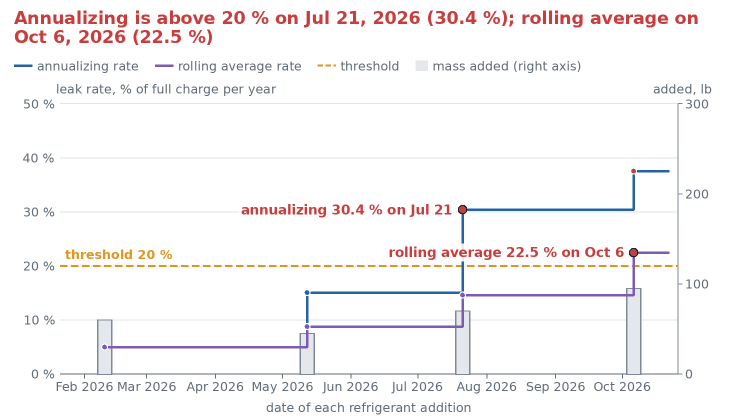
The annualizing method looks forward. It takes the one addition, divides it by the full charge, and scales the result to a year by the time the refrigerant took to leave: 365 divided by the days since refrigerant was last added. Seventy pounds lost in seventy days from a 1,200 lb charge is 5.8 % of the charge in 70 days, which is 30.4 % a year. If more than 365 days have passed, 365 is used, so a slow leak is never scaled down below what was actually added.
The rolling average method looks back. It adds up everything put into the appliance over the previous 365 days and divides by the full charge. Nothing is scaled. In the same log the appliance has taken 175 lb by the third addition, 14.6 % of the charge, and that is its rate. If a repair was followed by a successful follow-up verification test within the year, the sum starts again after that test.
The equations
| Quantity | Formula | Source |
|---|---|---|
| Annualizing method | rate = (mass added ÷ full charge) × 365 ÷ (shorter of: days since refrigerant was last added, or 365) × 100 % | 40 CFR 84.102, leak rate, (1) |
| Rolling average method | rate = (mass added over the previous 365 days, or since the last successful follow-up verification test if that is less than a year) ÷ full charge × 100 % | 40 CFR 84.102, leak rate, (2) |
| First calculation, annualizing | 365 days are taken as the days since the last addition | 40 CFR 84.106(b)(1) |
| First calculation, rolling average | the mass added since January 1, 2026 is taken | 40 CFR 84.106(b)(2) |
| Thresholds | 20 % commercial refrigeration; 30 % industrial process refrigeration; 10 % comfort cooling, refrigerated transport and other appliances | 40 CFR 84.106(c)(2) |
| Repair and initial verification test | addition date + 30 days (120 days if an industrial process shutdown is required) | 40 CFR 84.106(d), (e)(1) |
| Retrofit or retirement plan | 30 days, in the cases the paragraph lists | 40 CFR 84.106(h)(1) |
| Calendar-year percentage | mass added in the calendar year ÷ full charge × 100 %, against 125 %; report date March 1 of the next year | 40 CFR 84.106(j), (m)(4) |
The mass may be in pounds, as the regulation writes it, or in kilograms: every rate is a ratio of two masses, so the unit cancels. The tool converts the log and the full charge through the site's unit dictionary before it forms the ratio.
When the rate is calculated. 40 CFR 84.106(b) has the owner or operator calculate the leak rate every time refrigerant is added, except right after a retrofit, after the installation of a new appliance, or for an addition that qualifies as a seasonal variance. The tool calculates at every line of the log; leave those additions out.
Which method. The definition says the same method is to be used for all the appliances of an operating facility, and 84.106(b)(3) allows a change of method only after a facility is acquired, and only where no appliance is above its applicable rate by either method. The tool shows both so that the difference can be seen; choosing is outside it.
What follows from a rate above the threshold. The page lists the periods the section counts from the addition: 30 days (or 120) for repair and the initial verification test, 30 days for a retrofit or retirement plan in the cases of paragraph (h)(1), the 180-day (or 270-day) outer limit of the parts extension, and the inspection schedule of paragraph (g). It counts calendar days from the date of the addition. It cannot know whether a period is suspended by mothballing or extended under paragraph (f).
The rule this page was read from
- 40 CFR 84.102 and 84.106 were read from the Electronic Code of Federal Regulations on November 21, 2026 (text current through November 19, 2026). Both sections come from the final rule at 89 FR 82682 (October 11, 2024); 84.106(a)(4) applies the section as of January 1, 2026.
- At 91 FR 30532 (May 26, 2026) EPA proposed to add a paragraph 84.106(a)(3)(iii) taking road and intermodal container transport refrigeration units out of the section, and wrote that it was proposing no other amendment. The paragraph was not in the text on the day it was read.
- EPA's list of petitions under the American Innovation and Manufacturing Act, read the same day, shows three petitions to reconsider this rule as under review. The percentages, charge sizes and day counts are therefore inputs with dated defaults: change them if the text changes.
- Outside the section as read: a full charge under 15 pounds; a refrigerant that is neither a regulated substance nor a substitute with a global warming potential above 53; appliances containing solely an ozone-depleting refrigerant (those are under 40 CFR 82.157, which has the same two formulas and the same percentages from a full charge of 50 pounds); and the residential and light commercial air conditioning and heat pump subsector.
- A state can have its own refrigerant management rules with different charge sizes, percentages and reports. None is covered here.
What it assumes
- The refrigerant added equals the refrigerant lost, and each line of the log returned the appliance to its full charge.
- Additions on one date are one addition; additions on different dates are separate calculations. The definition lets several additions for the same leak count as one: enter those as a single line.
- The previous 365-day period of an addition runs from 364 days before it through its own date.
- A line marked "verified" is a successful follow-up verification test showing that all identified leaks were repaired. The rolling sum then holds only the additions after it.
- Additions dated before the "count from" date (January 1, 2026 by default) are listed and left out, and the first counted addition takes 365 days in the annualizing method.
- The full charge is the same for the whole log.
When it misleads
- A short interval inflates the annualizing rate. A top-up three days after the last one is scaled by 365 ÷ 3. That is what the formula gives, and it is the reason additions for the same leak belong on one line.
- The first addition is treated gently. With 365 days assumed, the first annualizing rate is simply the addition over the charge, however quickly the refrigerant was in fact lost.
- The rolling rate forgets. An addition drops out of the sum 365 days later, and the rate is only recalculated at the next addition, so the step line on the figure holds a value that is no longer current.
- A wrong full charge moves everything. Every percentage on the page scales inversely with it. If the charge was revised during the period, split the log.
- Purged and recovered refrigerant. Refrigerant purged and destroyed under 84.106(k), refrigerant recovered and put back, and seasonal adjustments are not leaks; a log that includes them overstates the rate.
Common mistakes
- Dividing by the days since the last service visit instead of the days since refrigerant was last added.
- Using the calendar year for the rolling average. The window is the previous 365 days from each addition; the calendar year belongs to the 125 % figure of 84.106(j) only.
- Scaling by more than a year: when 500 days have passed, the divisor is 365, not 500.
- Mixing the two methods, taking whichever is lower at each addition.
- Reading "20 %" as 20 % of the charge added at once. An addition of 6 % of the charge after 70 days is already above 20 % a year by the annualizing method.
- Forgetting that the thresholds differ by appliance type: 10 % for a comfort-cooling chiller, 20 % for a supermarket rack, 30 % for industrial process refrigeration.
- Applying the old 50-pound charge size to a refrigerant with no ozone-depleting component: 84.106 starts at 15 pounds.