Tools › Structures › Statics › Cable Sag and Tension › Method
Cable Sag and Tension: Method
Open the Cable Sag and Tension tool
Method: Catenary, Parabola, Point Load, What It Assumes, Common Mistakes
What the tool does
It finds the shape of a cable, rope or line hanging between two supports and the forces in it: the tension at each support, the sag, the length and the angles. You give the span, the loads and one more fact (the sag, the cable length or the horizontal tension); the tool solves the exact equations, draws your cable and shows the parabola beside it.
The idea: sag is what carries the load
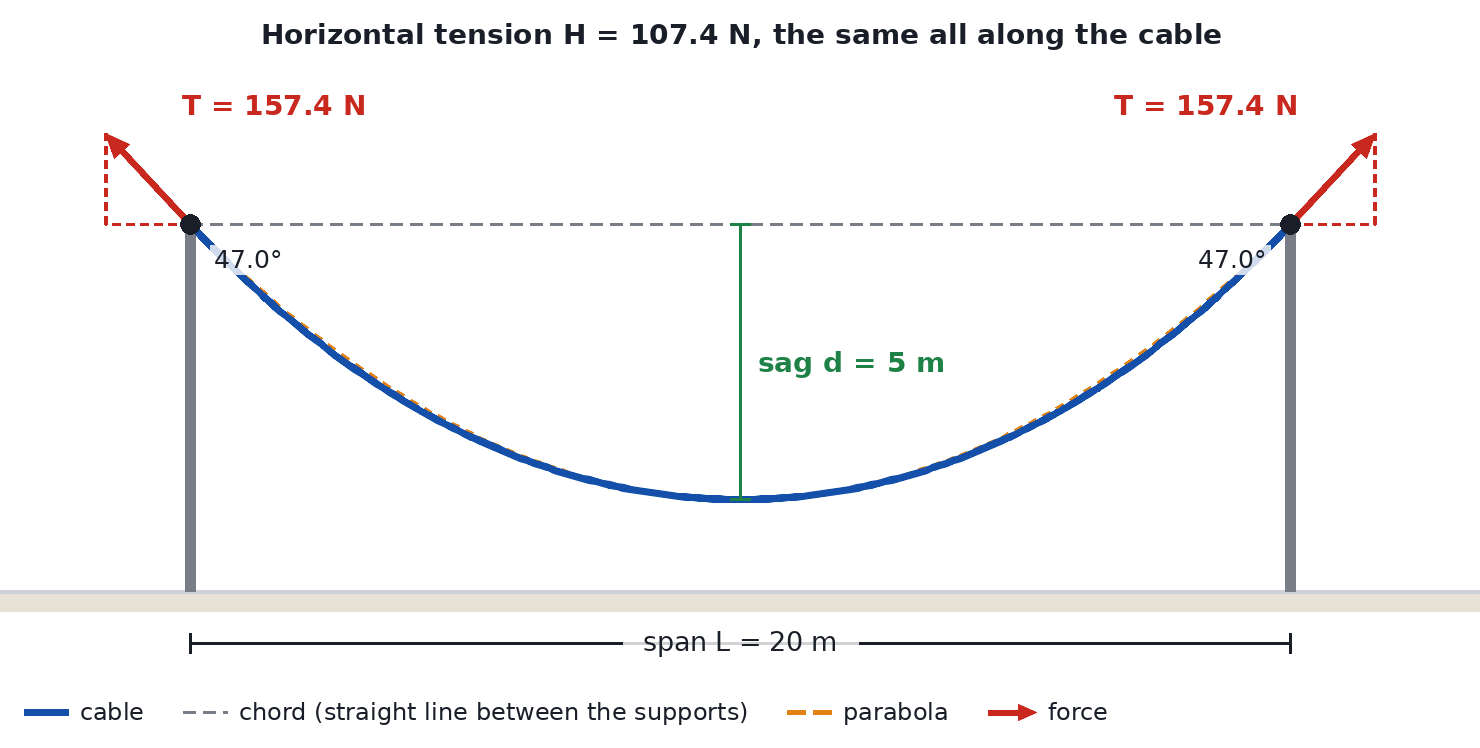
A cable can only pull along its own line. To hold a weight up, the pull at each end must point partly upward, so the cable must slope, and to slope it must sag. Split the tension T at any point into a horizontal part H and a vertical part V. Nothing pushes sideways on a hanging cable, so H is the same everywhere; the vertical part changes along the cable as it picks up load. The flatter the cable, the smaller the upward share of its pull, and the harder it must pull to carry the same weight. That is why no rope can be pulled perfectly straight.
The cable equation
Take x to the right, y up and write p = dy/dx for the slope. The vertical part of the tension is H p. A short piece of cable carries its own weight, w per unit of its length, and possibly a load q per unit of horizontal length (a deck hung from it). Vertical equilibrium of the piece gives
H dp/dx = w √(1 + p²) + q
and at a point load P the slope jumps by P / H. The tension is T = H √(1 + p²), so it is largest where the cable is steepest, which is always at a support. Three cases follow.
- Own weight only (q = 0): the catenary. The slope is p = sinh(w x / H + constant) and the curve is y = (H / w) cosh(w x / H + constant). For a level span L: sag d = (H / w) [cosh(w L / 2H) − 1], length S = (2H / w) sinh(w L / 2H), tension at the supports T = H cosh(w L / 2H) = H + w d. The length H / w is called the catenary parameter.
- Load per horizontal length only (w = 0): the parabola. The slope is linear in x. For a level span: H = q L² / (8 d), T = H √(1 + (4 d / L)²), S ≈ L + 8 d² / (3 L). This is exact for a light cable carrying a heavy uniform deck, which is why suspension-bridge cables are parabolas.
- A point load only: straight lines. With the load P at midspan of a level span, T = P / (2 sin θ), where θ is the angle of each half below the horizontal, and H = P L / (4 d).
With both w and q the tool integrates the equation numerically. With a point load the cable is two arcs that meet at a kink under the load.
A useful shortcut: the beam analogy
For loads given per horizontal length, the horizontal tension times the sag below the chord at any point equals the bending moment that a simply supported beam of the same span would have at that point under the same loads: H d = M. At midspan of a level span under a uniform load this is H = q L² / (8 d); with a point load P at midspan add P L / 4 to the moment. The tool prints this estimate first and the exact value after it. Treating the cable's own weight as if it were spread along the horizontal is the parabolic approximation.
How the tool solves it
- For a trial H, it finds the slope at the left support for which the cable arrives exactly at the right support (one unknown, found by bracketed root-finding).
- If the sag or the length is what you know, it changes H until that sag or length comes out. Both fall steadily as H rises, so there is one answer.
- From H and the end slopes: V = H p and T = H √(1 + p²) at each support; the two vertical forces add up to the total load, which the output checks.
The parabola column of the comparison table is the same solution with the cable weight spread evenly along the chord.
When the parabola is good enough
For a level cable under its own weight with the same sag, the parabola gives a horizontal tension that is low by about (4/3)(d / L)²: 0.3 % at a sag of 1/20 of the span, 1.3 % at 1/10, 2 % at 1/8 and 5 % at 1/5. Power lines and most tight lines sag a few percent of the span, so the parabola is close; a hammock or a slack chain needs the catenary. The difference also grows on steep spans.
What it assumes
- The cable is perfectly flexible (no bending stiffness) and does not stretch. The length you enter or read is the length under load.
- All loads are vertical and steady: weight, a hung deck, one point load. The supports do not move.
- The cable weight is uniform along its length and the deck load is uniform along the horizontal.
- The point load hangs from a fixed point of the cable (it does not roll to the lowest position by itself).
When it misleads
- Dynamic loads. A person bouncing on a slackline, a fall caught by a rope, a braking trolley, wind and galloping ice can multiply the static tension several times. The tool gives the static value only.
- Stretch and temperature. A real rope stretches under load and a metal conductor grows when warm. Both add sag and lower the tension; a line tensioned on a cold day is tighter than the same line in summer. Sag and tension tables for power lines include these effects; this tool does not.
- Very tight lines. When the sag is under about 1 % of the span, the result swings widely with a tiny change of sag or length, and stretch decides the real answer.
- Stiff members. A thick bar or pipe carries part of its load in bending and sags less than a cable.
- Strength. The ratio of breaking strength to tension is not a safety verdict. Working load limits are a fraction of the breaking strength, and knots, clamps and bends weaken a rope. This is not a design check for rigging that carries people.
Common mistakes
- Thinking a tighter line is a safer line. Halving the sag about doubles the tension. A 180 lb person at the middle of a 100 ft line that sags 3 ft puts about 1,500 lb in the line.
- Using the weight as the tension. The tension in a flat cable is many times the load it carries; only a cable hanging nearly straight down carries about half the load at each end.
- Mixing up the two kinds of distributed load. Cable weight acts per unit of cable length (catenary); a deck acts per unit of horizontal length (parabola). Using q L² / (8 d) for a deep, heavy chain underestimates the tension.
- Taking H for the largest tension. H is the smallest tension, found at the lowest point. The largest is at the higher (steeper) support: T = √(H² + V²).
- Measuring sag from the wrong line. On supports at different heights the sag is measured vertically from the straight line between the supports (the chord), not from the level of either support. The lowest point is not at midspan and can even lie outside the span, in which case the cable lifts the lower support.
- Splitting the load equally between uneven supports. With supports at different heights or a load off center the vertical forces differ; take moments about one support.
- Using the span for the cable length. The cable is longer than the chord, but often by very little: 1 % of extra length gives a sag of about 6 % of the span. Small errors in length are large errors in sag and tension.
- Forgetting half the bridge. A suspension bridge has two main cables; each carries half the deck load.
Where the numbers were checked
The catenary results reproduce the sag tables of Examples 3 and 4 of the Bureau of Reclamation Transmission Line Design Manual (pages 20 and 21) to the printed digits, and the parabola and point-load results reproduce the formulas of its Figures 7 and 41. Inclined spans, combined loads and point loads on a catenary were checked against an independent numerical integration of the cable equation (scipy). The Golden Gate case uses the span, sag and deck weight tabulated in the statics chapter cited below, with the cable weight left out as that chapter does; it is an illustration of the parabola, not the bridge's design load.