Tools › Finance and Business › Tax › S Corp versus Sole Proprietor › Method
S Corp versus Sole Proprietor: Method
Open the S Corp versus Sole Proprietor tool
S Corp versus Sole Proprietor: How It Works
What it does
The page takes one business profit and computes the federal tax on it twice: once as a sole proprietorship, where the whole profit is self-employment income, and once as an S corporation that pays its owner a salary and passes the rest of the profit through. It works both out line by line, sweeps the salary from zero to the full profit, and marks the salary at which the two totals are equal. It is an illustration, not tax advice, and it does not say what salary is reasonable compensation.
The idea
Social Security and Medicare tax is charged on earnings from work. A sole proprietor's whole profit counts as such earnings. In an S corporation only the owner's salary does; profit left after the salary reaches the owner's return as business income with no Social Security or Medicare tax on it. Three things push the other way: the corporation pays unemployment tax and costs money to run; the pass-through profit is smaller than the profit, because the employer's taxes and the yearly cost come out of it; and the qualified business income deduction is figured on the pass-through profit only, and above an income threshold it is capped by the wages the business pays.
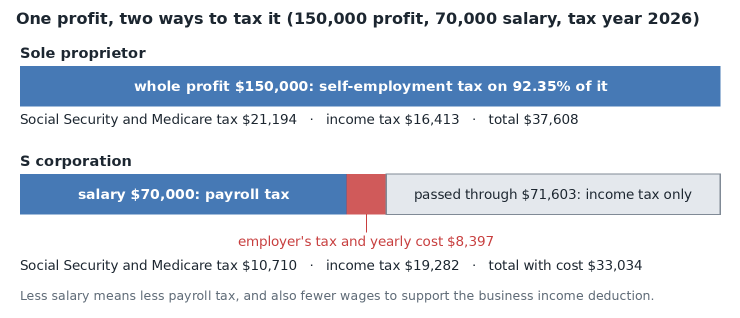
Sole proprietor (Schedule SE and Form 1040)
Net earnings from self-employment are 92.35% of the net profit (Schedule SE, line 4a); under 400 no tax is due. Self-employment tax is 12.4% of the net earnings up to the Social Security wage base plus 2.9% of all of them (lines 10 to 12). Half of the tax is deducted from income (line 13). Additional Medicare Tax of 0.9% applies to wages and net earnings above 200,000, or 250,000 on a joint return (Form 8959).
Taxable income before the business deduction = other income + profit − half of the self-employment tax − standard deduction. Qualified business income is the profit less that half (Instructions for Form 8995-A, "Determining your QBI"). Income tax comes from the rate schedule of the filing status.
S corporation at a salary W
The corporation pays 6.2% Social Security tax on the salary up to the wage base and 1.45% Medicare tax on all of it, and withholds the same from the owner (Publication 15). It pays federal unemployment tax: 6.0% on the first 7,000 of wages less a credit of up to 5.4% for state unemployment tax, so 0.6% with the full credit; and a state payroll tax if you enter one.
Pass-through profit K = profit − W − employer's Social Security and Medicare tax − unemployment tax − yearly cost. Taxable income before the business deduction = other income + W + K − standard deduction. The salary is not qualified business income (the instructions exclude reasonable compensation from an S corporation); K is. The salary counts as W-2 wages of the business.
The qualified business income deduction (Form 8995-A)
With taxable income before the deduction at or below the threshold, the deduction is 20% of qualified business income, and never more than 20% of that taxable income. Above the threshold the form adds two limits, phased in over a range of income:
| Step | Rule |
|---|---|
| Share of the range used | f = (taxable income − threshold) ÷ phase-in range, between 0 and 100% |
| Specified service business (Schedule A) | only the applicable percentage 100% − f of the income, wages and property basis counts; at f = 100% the business does not qualify |
| Line 3 | 20% of the qualified business income counted |
| Line 10, wage limit | the greater of 50% of W-2 wages, or 25% of W-2 wages plus 2.5% of the basis of qualified property |
| Lines 11 to 13 | if line 10 is below line 3: line 3 − f × (line 3 − line 10), which is line 10 itself once f reaches 100% |
| Line 36, income limit | 20% of taxable income before the deduction (the page assumes no net capital gain) |
| Minimum, from 2026 | at least 400 when qualified business income from a business the owner materially participates in is 1,000 or more |
A sole proprietor's own draw is not a wage. With no employees the wage limit is zero, so above the phase-in range the deduction of a sole proprietor falls to the minimum, while an S corporation's salary creates wages that support a deduction. That is why the curve of total tax against salary can bend: below a certain salary the deduction is capped at half the salary.
The 2026 figures and where they come from
Every yearly figure is an Advanced input. The defaults were read from: Rev. Proc. 2025-32, section 4.01 Tables 1 to 3 (rate schedules), section 4.14 (standard deduction 16,100 single, 32,200 joint, 24,150 head of household) and section 4.26 (threshold 201,750, or 403,500 joint; the range ends at 276,750, or 553,500 joint); Schedule SE (Form 1040) for 2026 and Publication 15 for 2026 (wage base 184,500; rates 6.2% and 1.45%; unemployment tax 6.0% on the first 7,000 less the credit); Form 8959 (0.9% above 200,000, or 250,000 joint, not indexed); Public Law 119-21, section 70105 (phase-in range 75,000, or 150,000 joint, and the 400 minimum with 1,000 of income, for tax years beginning after 2025). The seven income tax rates, 10% to 37%, are set by statute and are not inputs. The line layout of Form 8995-A is that of the 2025 form, the latest issued when the page was written; the Social Security Administration's own wage base page could not be opened, so the wage base rests on the two IRS documents.
Where the two totals are equal
The page evaluates the S corporation at 241 salaries from zero to the profit, and at the salaries where a rule changes (the wage base, the unemployment tax base, the Additional Medicare threshold). Where the S corporation total crosses the sole proprietor total it finds the salary by bisection. There may be no such salary, or more than one.
What it assumes
One owner who works in the business and has no other wages of their own; a full calendar year; the standard deduction (enter itemized deductions in its place if they are larger); ordinary income only; the business is one qualified trade or business with no loss carried forward; the owner materially participates; the yearly cost is deductible by the corporation; a pass-through loss, when the salary and its costs exceed the profit, is deducted in full. Income tax is computed from the rate schedule, not the Tax Table.
When it misleads
It is federal only. Several states tax S corporations or their income directly, and state income tax changes with the same numbers; these can outweigh the federal difference. It leaves out the self-employed health insurance and retirement plan deductions, both of which depend on the salary. It ignores that a lower salary lowers the Social Security earnings record. It treats every salary as possible: the instructions for Form 1120-S require payments to an officer to be treated as wages to the extent they are reasonable compensation for services, and IRS Fact Sheet 2008-25 says there are no specific guidelines for what is reasonable, only factors the courts weigh. A point on the chart is arithmetic, not a statement that the salary would be accepted.
Common mistakes
- Applying 15.3% to the whole profit. Schedule SE first multiplies by 92.35%, and the 12.4% part stops at the wage base.
- Counting only the employee's half of payroll tax. The corporation pays the other half, and it comes out of the same profit.
- Taking 20% of the whole profit as the deduction in both structures. For the S corporation it is 20% of the pass-through profit only; the salary earns no deduction.
- Forgetting the wage limit above the threshold. With no wages, 50% of wages is zero.
- Using the 2025 phase-in range of 50,000 (100,000 joint) for 2026. The range is 75,000 (150,000 joint) from 2026.
- Comparing taxes and leaving out the yearly cost of payroll and the corporate return, and the unemployment tax a sole proprietor does not pay.
- Subtracting the standard deduction twice by entering other income after deductions. Enter it before the standard deduction.
Checks
The library is tested against Schedule SE, Form 8959, Form 8995-A and its Schedule A filled in by hand for two cases, against the printed base amounts of the Rev. Proc. 2025-32 rate schedules, and against an independent Python computation written from the form lines. Related: Consulting Rate and Utilization prices the work; this page taxes the profit.