Tools › Finance and Business › Tax › Estimated Tax and Safe Harbor › Method
Estimated Tax and Safe Harbor: Method
Open the Estimated Tax and Safe Harbor tool
Estimated Tax and Safe Harbor: Four Installments, Three Tests, One Penalty
The tool takes last year's tax, this year's expected tax, the withholding and the estimated payments actually made, and works out how much the federal rules required by each of the four due dates and what the underpayment penalty comes to. It does this for equal installments and for the annualized income installment method of Form 2210, Schedule AI, which follows the income as it arrived. It is arithmetic on the numbers entered: an illustration, not tax advice.
The idea: the tax is checked four times a year, not once
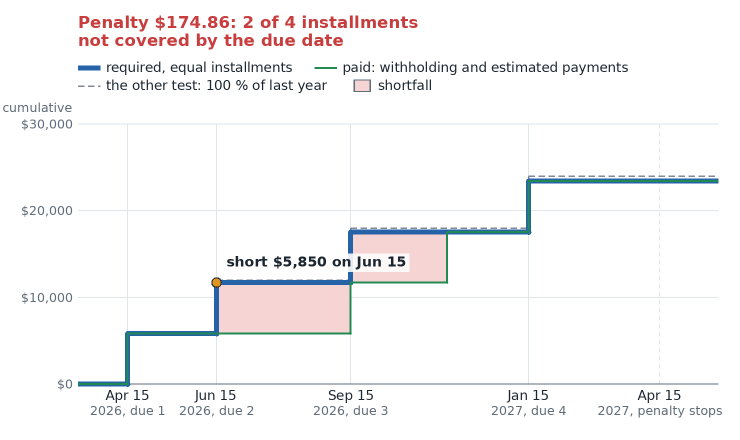
The federal income tax is pay-as-you-go. Tax that is not withheld is paid in four installments, due April 15, June 15, September 15 and January 15 (Internal Revenue Code section 6654(c)). At each of those dates the law compares two running totals: what was required so far and what was paid so far. Wherever the paid line sits below the required line there is an underpayment, and the penalty is interest on that gap for as long as it lasts. A refund at filing time does not undo a gap that existed in June.
How much is required for the year: three tests
The required annual payment is the smaller of two amounts (section 6654(d)(1); Form 2210, lines 5, 8 and 9):
| Test | Amount | When it is used |
|---|---|---|
| Current year | 90 % of this year's tax | always available; needs a good estimate of this year |
| Prior year | 100 % of last year's tax | last year's return covered 12 months and its adjusted gross income was $150,000 or less ($75,000 or less, married filing separately) |
| Prior year, higher income | 110 % of last year's tax | last year's adjusted gross income was above that threshold |
The prior-year test is called a safe harbor because it is known in advance: someone whose income doubles owes no penalty if withholding and four timely installments add up to last year's tax (or 110 % of it), although the rest of the tax is still due with the return. Two exceptions remove the penalty altogether: this year's tax less withholding is under $1,000, or last year's 12-month return showed no tax liability (section 6654(e)).
How much is required at each date
Equal installments. Each installment is 25 % of the required annual payment.
Annualized income installment method. When income arrives unevenly (a seasonal business, a large sale in December), equal installments ask for tax in April on income not yet received. Schedule AI lets each installment follow the income instead. For each period, from January 1 through March 31, May 31, August 31 and December 31:
| Step | Formula | Schedule AI |
|---|---|---|
| Annualized income | income of the period × 4, 2.4, 1.5 or 1 | lines 1 to 3 |
| Tax on it | the tax of a full year with that income, after deductions and credits, with self-employment and other taxes | lines 4 to 19 |
| Share due so far | 22.5 %, 45 %, 67.5 % or 90 % of that tax | lines 20 and 21 |
| Annualized income installment | that share less the installments required earlier (not below zero) | lines 22 and 23 |
| Cap | the equal installment plus everything earlier installments were lowered by | lines 24 to 26 |
| Required installment | the smaller of the last two | line 27 |
The cap is the recapture rule of section 6654(d)(2)(A)(ii): whatever the method saved early is added back to later installments, so the four never add up to more than the required annual payment. Self-employment tax is annualized the same way (Schedule AI, Part II): net earnings are 92.35 % of the profit of the period; the social security part is 12.4 % up to the wage base prorated to the period; the Medicare part is 2.9 % of all of it; and half of the result, brought back to the period, is deducted from the period's income (Publication 505, Worksheet 2-9, lines 33 to 43).
The tool offers two ways to get the tax on each annualized income. With the rate schedule it applies the 2026 Tax Rate Schedule of the filing status after one deduction and adds the self-employment tax. With your own tax figures you enter the tax of each period yourself, which is how capital gain rates, credits, the alternative minimum tax or the net investment income tax are brought in.
The penalty
| Quantity | Formula | Source |
|---|---|---|
| Underpayment of an installment | required installment − amount credited to it by its due date | section 6654(b)(1); Form 2210, line 17 |
| Crediting order | each payment goes to the oldest installment not yet paid in full | section 6654(b)(3) |
| Withholding | one quarter counts as paid on each due date | section 6654(g)(1) |
| Period | from the due date to the day that part is paid, at the latest April 15 after the year | section 6654(b)(2) |
| Penalty of one piece | amount × days ÷ days in the year × rate, for the days falling in each rate period | Instructions for Form 2210, penalty worksheet |
The rate is the underpayment rate the IRS sets for each calendar quarter (section 6621), so one late piece can pass through several rates: the worksheet splits its days at June 30, September 30 and December 31. The rate of the first quarter of the following year also covers April 1 to 15.
The 2026 figures in the form, and where each was read
| Figure | Default | Read from (2026-11-21) |
|---|---|---|
| Percentages of the tests | 90, 100, 110 | 26 U.S.C. 6654(d)(1); Form 1040-ES (2026), page 1 |
| Adjusted gross income threshold | $150,000; $75,000 married filing separately | 26 U.S.C. 6654(d)(1)(C); Form 1040-ES (2026), page 1 |
| Due dates | April 15, June 15, September 15, 2026; January 15, 2027 | Form 1040-ES (2026), page 5; Publication 505 (2026), page 25 |
| Annualization amounts and percentages | 4, 2.4, 1.5, 1; 22.5, 45, 67.5, 90 % | Form 2210 (2025), Schedule AI, lines 2 and 20; Publication 505 (2026), page 40 |
| Underpayment rate, April 16 to June 30, 2026 | 6 % | Revenue Ruling 2026-5 |
| Underpayment rate, July 1 to September 30, 2026 | 7 % | Revenue Ruling 2026-10 |
| Underpayment rate, October 1 to December 31, 2026 | 7 % | Revenue Ruling 2026-15 |
| Underpayment rate, January 1 to April 15, 2027 | 7 % (placeholder) | not published on 2026-11-21; repeats the quarter before; check before use |
| Tax Rate Schedules and standard deduction | by filing status | Form 1040-ES (2026), pages 2 and 10; Publication 505 (2026), page 31 |
| Self-employment tax figures | 92.35 %, 12.4 % up to $184,500, 2.9 % | Form 1040-ES (2026), pages 2 and 9; Publication 505 (2026), page 41 |
What it assumes
An individual on the calendar year, a U.S. citizen or resident, with four installments on the dates entered. Withholding is spread in four equal parts. The amounts entered for last year and this year are the "tax" of section 6654(f): total tax less credits, self-employment tax included. With the rate schedule, all income is ordinary income, one deduction is the same in every period, and nothing but self-employment tax is added. The penalty runs to April 15 after the year on anything still unpaid, and each rate-period piece is rounded to the cent.
When it misleads
When this year's tax is itself uncertain: the 90 % test and the annualized method both rest on the figure entered, and the IRS computes from the return as filed. When income includes capital gains, qualified dividends or a qualified business income deduction and the rate schedule is used without them. When withholding was uneven and the taxpayer elects actual dates (enter those amounts as dated payments instead). When a due date is moved for a disaster area, or a waiver applies. When a return is filed and the balance paid by January 31, which removes the fourth installment's penalty (section 6654(h)). The tool does not cover farmers and fishers (one installment, 66⅔ %), estates and trusts, nonresident aliens, fiscal years, corporations or any state's estimated tax.
Common mistakes
- Thinking a refund means no penalty. Each installment stands alone; paying everything in January leaves April, June and September short.
- Using 100 % of last year's tax when last year's adjusted gross income was over $150,000. The figure is then 110 %.
- Comparing with last year's refund or balance due. The prior-year test uses last year's total tax, not what was owed at filing.
- Dividing the year into quarters. The periods end March 31, May 31, August 31 and December 31: two, three and four months long after the first.
- Annualizing with the wrong multiple. Five months of income is multiplied by 2.4, eight months by 1.5.
- Forgetting the recapture. The annualized method lowers early installments only for a while; the reduction comes back in a later installment up to the required annual payment.
- Assuming a late payment covers the installment it was sent for. It is credited to the oldest unpaid installment first.
- Applying one interest rate to the whole year. The rate can change every quarter.
Sources: Internal Revenue Code sections 6654 and 6621; Form 2210 and its instructions; Form 1040-ES; Publication 505. An illustration, not tax advice.