Tools › Finance and Business › Human Resources › Overtime and Back Wages › Method
Overtime and Back Wages: Method
Open the Overtime and Back Wages tool
Overtime and Back Wages: the Regular Rate, Week by Week
The tool takes a worker's weeks (hours, pay, bonuses, overtime actually paid) and works out, for each week, the regular rate of pay, the overtime premium that rate calls for under the federal Fair Labor Standards Act, and the difference from what was paid. It adds the weekly differences into a back-wage total. It is arithmetic on the numbers entered: an illustration, not legal advice.
The idea: overtime is paid on the regular rate, not on the base rate
Federal law sets overtime at one and one-half times the regular rate for hours past 40 in a workweek (29 U.S.C. 207(a)(1)). The regular rate is not the number printed on a job offer. It is a rate per hour found again every week: all pay for the week that counts as remuneration, divided by all hours worked in that week (29 CFR 778.109). A production bonus, a night-shift differential or a commission is part of that pay, so it lifts the rate for every hour of the week, including the overtime hours.
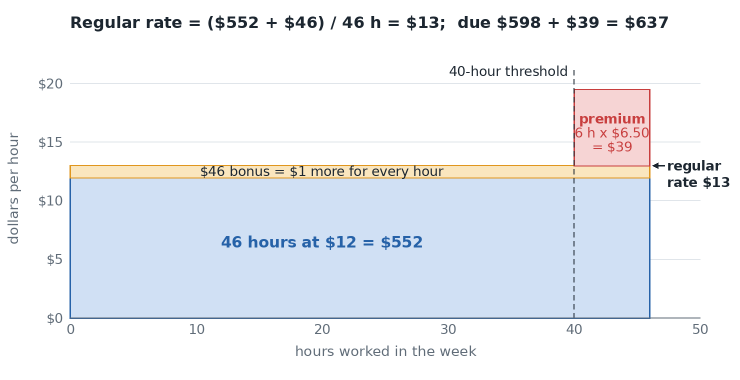
In that example of the regulation, 46 hours at $12 give $552; the $46 bonus makes $598; $598 ÷ 46 hours is a regular rate of $13. Straight time has already been paid for all 46 hours, so what is still due for the 6 overtime hours is the extra half: 6 × $6.50 = $39, and the week's total is $637. An employer who pays "time and a half" on the $12 base pays 6 × $6 = $36 of premium: $3 short for that week. Small, but it repeats every overtime week, and a quarterly bonus reaches back over thirteen of them.
The equations
| Quantity | Formula | Source |
|---|---|---|
| Regular rate of a week | R = (straight-time pay + other pay counted) ÷ hours worked | 29 CFR 778.109 |
| Overtime hours | hover = hours worked − 40 (when positive) | 29 U.S.C. 207(a)(1) |
| Overtime premium due | P = (1.5 − 1) × R × hover | 29 CFR 778.110 |
| Two hourly rates in one week | R = (hA rA + hB rB + other pay) ÷ (hA + hB), the weighted average | 29 CFR 778.115 |
| Salary for a fixed workweek | hourly rate of the salary = salary ÷ hours it covers; R = that rate + other pay ÷ hours worked; hours past those covered are also due at the salary's rate | 29 CFR 778.113, 778.325 |
| Salary for all hours worked | R = (salary + other pay) ÷ hours worked; only the extra half is due | 29 CFR 778.114 |
| Bonus covering several weeks | share of a week = bonus ÷ number of weeks, or bonus × week's hours ÷ hours of the period | 29 CFR 778.209(b) |
| Back wages | sum over the weeks of (due − paid), each week counted only when positive | 29 CFR 778.104 |
The premium is the extra half only when straight time was paid for every hour. The overtime rate is 1.5 × R. If the worker has already received straight time for all hours worked, including the overtime hours, what remains is 0.5 × R for each overtime hour. A pay stub usually shows overtime differently: the overtime hours appear on their own line at the full overtime rate. The tool reads either form. With "Pay stub overtime line" it takes straight time for the overtime hours out of that line (at the week's average hourly rate) and credits the rest against the premium; with "Premium only" it credits the entered amount as it stands.
A bonus for more than one week. When a bonus is earned over a quarter or a year, the overtime of those weeks has usually been paid already, without it. The regulation has the bonus apportioned back over the workweeks of the period in which it was earned; where it cannot be tied to particular weeks, an equal amount each week is one reasonable method and an equal amount each hour worked is another (29 CFR 778.209(b)). Each overtime week then carries additional pay of half the hourly increase times its overtime hours. A bonus that is a percentage of total earnings, straight time and overtime alike, already includes its own overtime (29 CFR 778.210); it is not entered here.
Two kinds of salary. A salary does not by itself end overtime; only an exemption does, and exemptions are outside this page. For a nonexempt salaried worker the regulation turns the salary into an hourly rate. If the salary is pay for a fixed number of hours (say $880 for 40), the rate is the salary over those hours, and every hour past them is due at that rate plus the half-time premium past 40: time and a half in full when the salary covers 40 hours. If the understanding is that the salary is straight-time pay for whatever hours the week brings, the rate falls as the hours rise and only the extra half is due (the fluctuating workweek method, which carries conditions of its own in 29 CFR 778.114(a) that this page does not test).
Rounding. The examples printed in the regulation and in the Department of Labor's fact sheets round the regular rate to the cent, then the half-time rate to the cent, then multiply by the overtime hours: $600 ÷ 44 hours is printed as $13.64 and four overtime hours as $27.28, where unrounded arithmetic gives $27.27. The tool opens on the printed convention so that it reproduces those examples to the cent, and offers unrounded rates in Advanced mode.
Liquidated amount, interest and look-back. 29 U.S.C. 216(b) provides for the unpaid overtime compensation and an additional equal amount as liquidated damages, and 29 U.S.C. 260 lets a court award less or none where the employer shows good faith and reasonable grounds. 29 U.S.C. 255(a) allows an action within two years, three where the statute's willfulness condition is met. In Advanced mode the tool can show the equal amount, simple interest at a rate you enter, and totals limited to the most recent rows. These are figures for discussion; which of them applies in a given matter is a legal question the page does not answer.
What it assumes
- Every row is one workweek of the same worker, in order, and the hours entered are the hours actually worked. Each workweek stands alone: hours are never averaged across weeks (29 CFR 778.104).
- The "other pay" you enter is pay that counts toward the regular rate. Section 207(e) of the Act excludes some payments (gifts, discretionary bonuses, pay for time not worked, reimbursed expenses and others); leaving those out is up to you.
- Straight-time pay and the other pay were actually paid. The tool measures the overtime shortfall only; unpaid straight time or a rate below the minimum wage is a different computation.
- Weeks in which more was paid than the computed amount do not reduce the shortfall of other weeks; their total is reported separately.
- Interest, when asked for, is simple, and the rows are consecutive weeks.
When it misleads
- State law. A state may count overtime by the day, set its own threshold or multiple, or define the regular rate differently. The threshold and the multiple are inputs, but daily rules are not modeled, so the figures can differ from what a state rule gives.
- Exempt employees and special provisions. Nothing here tests whether a worker is exempt, or covered by a provision with its own arithmetic (the 8 and 80 system of hospitals, section 7(i) commissions, section 7(k) public safety, piece-rate agreements under section 7(g), tipped employees).
- Hours that were never recorded. The answer is only as good as the hours. Off-the-clock work, automatic meal deductions and rounding of time punches change the hours before any rate is computed.
- Premiums that count as overtime already. Extra pay for hours past eight in a day or for weekends at a qualifying premium rate may be credited toward overtime and left out of the regular rate (29 CFR 778.201 to 778.207). Entering such a premium as "other pay" overstates the regular rate.
- The pay stub credit with two rates. When a week has two hourly rates, the straight time taken out of the pay stub's overtime line uses the week's average rate; an employer who paid the overtime hours at one particular rate will show a slightly different split, though the week's total due is the same.
Common mistakes
- Paying overtime at 1.5 times the base hourly rate when the week also carried a bonus, a shift differential or a commission.
- Leaving a quarterly or annual bonus out of the overtime of the weeks in which it was earned.
- Paying each of two jobs its own overtime rate, or the lower one, where the regular rate is the weighted average of both.
- Dividing a salary by 40 when it was agreed for 35 or 45 hours, or dividing by the hours worked when it was agreed for a fixed week.
- Averaging a 30-hour week with a 50-hour week and finding no overtime.
- Multiplying the whole regular rate by 1.5 for the overtime hours and then adding straight time for the same hours again (paying those hours two and a half times).
- Treating a salaried worker as outside overtime because of the salary alone.
The tool's test reproduces the printed examples of 29 CFR 778.110, 778.113, 778.114(b), 778.120 and 778.325 and of Department of Labor Fact Sheets 23, 54 and 56C to the cent.