Tools › Structures › Stress Concentrations › Two Holes › Method
Two Holes: Method
Two Round Holes in an Infinite Plate under General In-plane Load
Problem Statement
An infinite thin plate of thickness t contains two round holes of diameters D1 and D2 (radii a1, a2) whose centers lie on the x axis a distance s apart, hole 1 at the origin and hole 2 at x = s. Far from the holes the plate carries a uniform in-plane stress state given by the resultants Nxx, Nyy, Nxy, so that σxx∞ = Nxx/t acts along the line of centers, σyy∞ = Nyy/t across it and τxy∞ = Nxy/t in shear. The holes interact: under a load across the line of centers the ligament between them crowds the stress and the peaks on the x axis of each hole rise above Kirsch's 3σ (at the outer points for moderate spacing, where the other hole's σxx lowers the facing point, and at the facing points once the holes are close); under a load along the line each hole shields the other and the peaks fall below 3σ and move away from the ligament; a small hole beside a large one sees the large hole's own concentration as its far field and can reach twice Kirsch's factor. The questions are the stress at a point P(r, θ) about hole 1, θ measured from the y axis towards x, the peak hoop stress on each hole, the gross factors Ktg = σmax/S1 referred to the maximum far-field principal stress, and the stresses in the ligament.
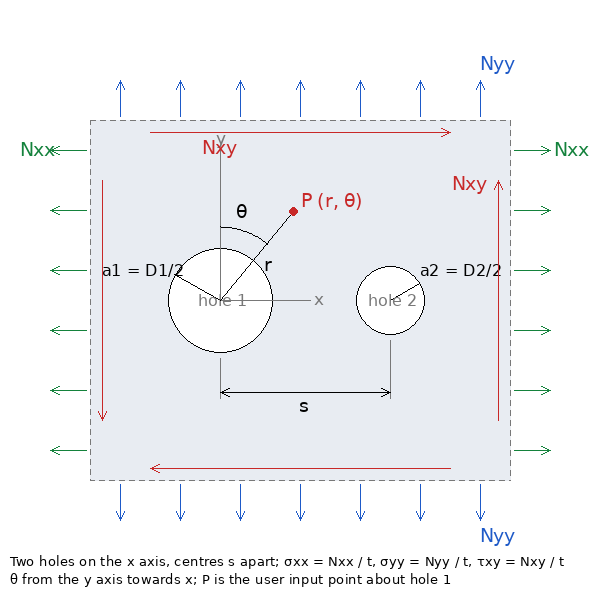
Figure A: Convention. Hole 1 is at the origin and hole 2 at x = s; θ is measured from the y axis towards x about each hole's own center, the same convention as the other hole tools, so θ = 90° on hole 1 and θ = −90° on hole 2 are the two points facing each other.
Key Assumptions
Infinite plate, two round holes, linear elastic, plane stress, uniform far field. Both holes are traction-free and carry no resultant force; the solution does not depend on the elastic constants (it is the same in plane strain). The material stays elastic at the peak. The series is carried to convergence as long as the gap between the edges is at least a fifth of the larger diameter (equal holes: D/s ≤ 0.833). A finite plate, a third hole or a row of holes are outside the tool (the row has its own tool).
Solution by Superposed Single-hole Expansions
With Muskhelishvili's potentials Φ(z) and Ψ(z) the stresses are σxx + σyy = 4 Re Φ and σyy − σxx + 2iτxy = 2[z̅ Φ′ + Ψ]. Each traction-free hole without a resultant force contributes the Laurent terms αn (z − c)−n to Φ and βn (z − c)−n to Ψ, n ≥ 2 (Kirsch's solution is n = 2, 4), about its own center c. For two holes the two expansions are added to the far field,
Φ(z) = Γ + ∑j=1,2 ∑n αn(j) (z − cj)−n, z̅ Φ′ + Ψ = Γ′ + ∑j ∑n [ βn(j) − n αn(j) e−2iφj ] (z − cj)−n,
with φj the polar angle about hole j, Γ = (σxx∞ + σyy∞)/4 and Γ′ = (σyy∞ − σxx∞)/2 + iτxy∞. The geometry is symmetric about the x axis, so the normal loads give real coefficients and the shear load imaginary ones; the two are solved separately and superposed. Each hole's terms leave tractions on the other hole, so the coefficients of both holes are found together by imposing σrr = τrθ = 0 at Nj + 12 points of the upper half of each hole in a least-squares sense (Horii and Nemat-Nasser 1985), the order Nj following aj/(s − ak) (8 at D/s = 0.1, 19 at 0.5, 52 at 0.8 for equal holes; a large hole beside a small one needs the higher order on the large hole). Ling (1948) solved the equal-hole problem exactly in bipolar coordinates and Haddon (1967) the unequal-hole problem by complex potentials; the series reproduces both.
Stress Concentration Factors
The hoop stress on each edge is scanned for its extremes. The gross factors Ktg = σmax/S1 are referred to the maximum far-field principal stress, as in the other general-load tools (S2 when S1 is not tensile). In an infinite plate the ligament has no net-section stress of its own; Peterson's charts for the load across the line of centers use the convention σnom = σ √(1 − λ²)/(1 − λ), λ = D/s, which the tool prints for equal holes together with the fitted polynomials of Pilkey's tables:
tension along the line of centers (Chart 4.21): Ktg = 3.000 − 0.712λ + 0.271λ²,
tension across the line of centers (Chart 4.22): Ktn = 3.0000 − 3.0018λ + 1.0099λ²,
equal biaxial tension (Chart 4.23): Ktn = 2.000 − 2.119λ + 2.493λ² − 1.372λ³.
Table 1 compares the converged series with these fits and Table 2 with the values of Ling, Haddon and Chiang collected by Badiger and Ramakrishna (2024), for equal holes and for a hole beside a larger one. The series reproduces the exact values to every printed digit; the fits are within 1 % of it for λ ≤ 0.6 and the across-the-line fit falls below it by 2 % at λ = 0.7 and 8 % at 0.8. The tool's values are the converged series.
| D/s | along: Ktg | fit | across: Ktg | across: Ktn | fit | biaxial: Ktn | fit |
|---|---|---|---|---|---|---|---|
| 0.1 | 2.980 | 2.932 | 3.001 | 2.714 | 2.710 | 1.819 | 1.812 |
| 0.2 | 2.927 | 2.868 | 3.004 | 2.453 | 2.440 | 1.673 | 1.665 |
| 0.3 | 2.853 | 2.811 | 3.015 | 2.212 | 2.190 | 1.557 | 1.552 |
| 0.4 | 2.777 | 2.759 | 3.035 | 1.987 | 1.961 | 1.465 | 1.464 |
| 0.5 | 2.715 | 2.712 | 3.066 | 1.770 | 1.752 | 1.392 | 1.392 |
| 0.6 | 2.670 | 2.670 | 3.116 | 1.558 | 1.563 | 1.330 | 1.330 |
| 0.7 | 2.642 | 2.634 | 3.381 | 1.420 | 1.394 | 1.272 | 1.268 |
| 0.8 | 2.623 | 2.604 | 4.034 | 1.345 | 1.245 | 1.219 | 1.198 |
| b/a | g/a | load | series | Ling 1948 | Haddon 1967 | Chiang | finite elements |
|---|---|---|---|---|---|---|---|
| 1 | 1 | along | 2.650 | 2.623 | 2.650 | 2.625 | 2.682 |
| 1 | 2 | along | 2.715 | 2.703 | 2.715 | 2.703 | 2.752 |
| 1 | 4 | along | 2.827 | 2.825 | 2.827 | 2.825 | 2.863 |
| 1 | 1 | across | 3.264 | 3.264 | 3.264 | 3.264 | 3.316 |
| 1 | 2 | across | 3.066 | 3.066 | 3.066 | 3.066 | 3.108 |
| 1 | 4 | across | 3.020 | 3.020 | 3.020 | 3.020 | 3.062 |
| 2 | 1 | along | 2.925 | 2.924 | 2.961 | ||
| 3 | 1 | along | 2.982 | 2.982 | 3.021 | ||
| 4 | 1 | along | 2.996 | 2.993 | 3.035 | ||
| 2 | 1 | across | 4.051 | 4.051 | 4.112 | ||
| 3 | 1 | across | 4.854 | 4.854 | 4.899 | ||
| 4 | 1 | across | 5.545 | 5.537 | 5.583 |
For the unequal pairs the peak of the load across the line sits on the small hole (4.051 at b/a = 2 against 3.263 on the large one), and the peak of the load along the line sits on the large hole, which is nearly undisturbed (2.925 to 2.996) while the small hole in its shadow falls to 2.0, 1.5 and 1.1.
Checks
A center distance of 2000 radii gives Kirsch's 3 and −1 on each hole; the field of two equal holes is symmetric about x = s/2 to 10−14; the root-mean-square traction left on the two edges is below 3 × 10⁻⁸ of the load (10−13 for close holes, where the order is higher); pure shear at s = 4a gives 4.55 against 4 for a single hole; the results do not change when the order is doubled.
Limitations
The tool stops when the gap between the edges is less than a fifth of the larger diameter (equal holes: D/s > 0.833), where the series needs more than 60 terms per hole and the page takes several seconds; Ling's and Haddon's solutions reach closer spacings. It does not cover a finite plate, a hole near a straight edge, three or more holes, or holes of different shape. The hoop stress in Figure 1 is referred to the nearer hole center, so the color field has a seam where the reference center changes.