Tools › Structures › Stress Concentrations › Spherical Cavity › Method
Spherical Cavity: Method
Open the Spherical Cavity tool
Spherical Cavity in an Infinite Solid under Uniaxial Tension
Problem Statement
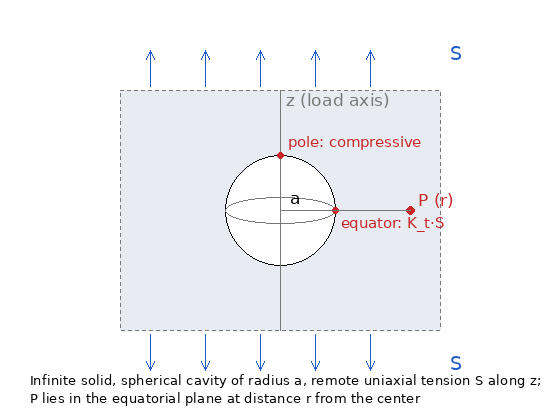
An infinite isotropic elastic solid contains a spherical cavity of radius a (a pore, a gas void, a casting defect) and carries a remote uniaxial tension S along z. Wanted are the stress concentration on the cavity surface and the decay of the stress away from it.
Key Assumptions
Infinite solid, linear elastic isotropic, traction-free cavity, uniaxial remote stress. Biaxial or triaxial remote states superpose (hydrostatic tension gives 1.5S all over the surface); an ellipsoidal cavity, a cavity near a free surface or a cluster of pores are different problems.
Solution
Southwell and Gough (1926) and Goodier (1933) solved the problem in spherical coordinates with the Boussinesq–Papkovich displacement potentials. On the cavity surface the axial stress is largest on the equator, the circle in the plane normal to the load,
Kt = (27 − 15ν) / [2(7 − 5ν)] (1.93 for ν = 0, 2.05 for ν = 0.3, 2.17 for ν = 0.5),
and the poles on the load axis are in compression, σ = −(3 + 15ν)S/[2(7 − 5ν)] (−0.68S at ν = 0.3). Along the equatorial radius
σz(r) = S[1 + (4 − 5ν)a³/(2(7 − 5ν)r³) + 9a5/(2(7 − 5ν)r5)],
which gives the equatorial factor at r = a (the tool's built-in check) and decays as (a/r)³: the disturbance is confined to about two radii, against three or four for the plate hole whose field decays as (a/r)².
Why Less than 3
In a plate the load diverted by a hole must pass on either side of it in the plane. Around a sphere it can pass on all sides, so the equatorial stress rises by only about 2 instead of 3, and the result depends on Poisson's ratio because the lateral contraction of the surrounding material contributes to the equatorial strain. The same effect makes a cylindrical hole in a thick body (plane strain) keep the factor 3 while a spherical pore of the same size is far less severe, which is why porosity is less damaging than a through hole of the same diameter, though pores near a surface or in clusters interact.
Limits
- Only the equatorial-plane distribution is given; the full field is available in Timoshenko and Goodier.
- Fatigue: a pore acts as a crack initiator; the elastic factor is the starting point, and the small-defect size effect (Murakami's √area approach) is a separate method.