Tools › Structures › Stress Concentrations › Semicircular Edge Notch › Method
Semicircular Edge Notch: Method
Open the Semicircular Edge Notch tool
Semicircular Edge Notch in a Semi-infinite Plate under Tension
Problem Statement
A large thin plate of thickness t has a straight free edge (the line x = 0, plate at x > 0) with a semicircular notch of radius ρ cut into it, centered on the edge. Far from the notch the plate carries a uniform tension σ = Nyy/t parallel to the edge; this is the only uniform far-field state a free edge admits, since a normal or shear stress at infinity would load the edge. The questions are the stress at a point P(r, θ) about the notch center, θ measured from the load axis y towards x (into the plate), the hoop stress along the notch with the factor Kt = σroot/σ at the root θ = 90°, and the stresses on the root line and along the free edge.
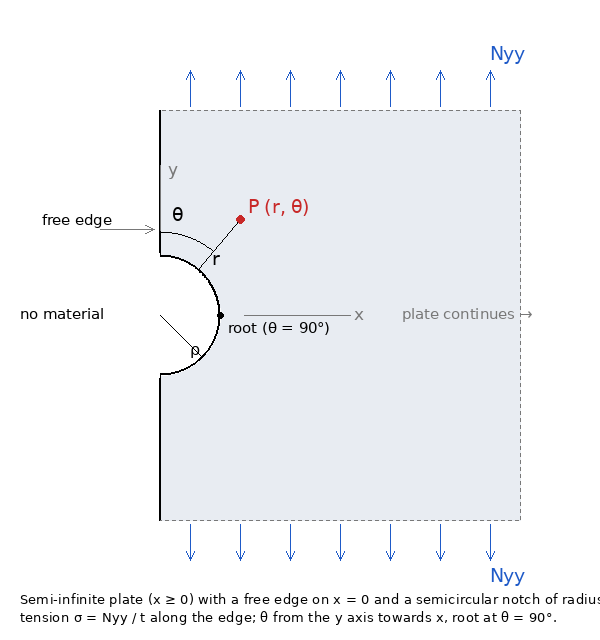
Figure A: Convention. The free edge is x = 0, the load acts along y, and θ runs from 0 (corner) through 90° (root) to 180° (the other corner), the same angle convention as the hole tools.
Key Assumptions
Semi-infinite plate, linear elastic, plane stress, exactly semicircular notch, tension parallel to the edge. The notch and the straight edge are traction-free. The solution does not depend on the elastic constants (it is the same in plane strain). The material stays elastic at the root. A strip of finite width, a second notch on the opposite edge, a U-notch deeper than its radius or a load with bending are outside the tool (Peterson's Charts 2.2–2.5 cover them; the present value is their limit for a notch small against the width).
Series Solution with an Exactly Free Edge
With the potentials Φ(z) and Ψ(z) the stresses are σxx + σyy = 4 Re Φ and σyy − σxx + 2iτxy = 2[z̅ Φ′ + Ψ] (in the solver's frame, with the edge on the real axis and the plate below it). The traction on the straight edge is σyy − iσxy = Φ + Φ̅ + conj(z̅Φ′ + Ψ). Writing Φ̅(z) = conj Φ(z̅), the condition that the whole line be free is an identity between analytic functions, which Muskhelishvili's continuation across the boundary solves at once:
Ψ(z) = −Φ̅(z) − Φ(z) − zΦ′(z).
So only Φ is unknown, and Ψ must be analytic in the plate, which requires Φ to be analytic both in the plate and in its mirror image above the edge, that is, everywhere outside the circle |z| = ρ. Hence Φ(z) = σ/4 + ∑n≥1 an z−n, a Laurent series about the notch center, with an real for even n and imaginary for odd n by the symmetry about the root line; the straight edge is then free identically, the far field is the uniform tension, and the Laurent coefficients are found by imposing σrr = σrθ = 0 at 2N + 40 points of a quarter of the notch in a least-squares sense. The notch meets the edge in two free 90° corners, where the stresses vanish; the series converges algebraically there and geometrically elsewhere, so N = 60 terms are kept (root value 3.0413, 3.0622, 3.0657, 3.0653, 3.0653 for N = 10, 20, 40, 60, 100). Maunsell (1936) and Ling (1947) solved the same problem with biharmonic series in the Airy function.
Results
| location | value / σ |
|---|---|
| notch root, θ = 90° (Kt) | 3.065 |
| notch, θ = 60° and 120° | 2.146 |
| notch, θ = 30° and 150° | 0.441 |
| notch, θ = 10° and 170° | −0.047 |
| corners, θ = 0 and 180° | 0 |
| free edge, y = 1.2ρ / 2ρ / 3ρ / 5ρ | −0.040 / 0.367 / 0.680 / 0.877 |
The root carries 3.065 σ, 2 % more than Kirsch's hole, because the free edge removes the restraint of the material on the open side. The hoop stress falls to zero at the corners and is slightly compressive next to them; along the free edge the stress is zero at the corner, dips to −0.04 σ and returns to σ within a few radii. The disturbance decays as 1/r² with no resultant force (the 1/z coefficient of the series is zero).
Checks
The traction on the straight edge is zero to round-off at every point by construction; the root-mean-square traction left on the notch is 1.3 × 10⁻⁴ σ for N = 60 (largest next to the corners); the resultant of the tractions on large semicircles of 5, 50 and 500 radii is zero to 10−5 (equilibrium) and the field tends to the uniform tension as 1/r²; the corner stresses tend to zero as the order rises (0.013, 0.006, 0.003, 0.0007 σ for N = 20, 40, 60, 100). The root factor 3.065 agrees with Ling (1947) as quoted by Peterson (Chart 2.2) and with Maunsell's 3.05.
Limitations
The notch is exactly semicircular and centered on the edge; U-notches of other depth, V-notches and notches in a strip of finite width are different problems (Peterson's Charts 2.2 to 2.5; the strip with two opposite semicircular notches was solved by Ling 1947 and Isida 1953). Only the tension parallel to the edge is admissible as a uniform far field; in-plane bending of a notched beam is not covered. The stresses are those of the elastic plate; the elastic root stress exceeds the yield strength of most metals at modest loads.