Tools › Structures › Stress Concentrations › Row of Holes › Method
Row of Holes: Method
Row of Round Holes in an Infinite Plate under General In-plane Load
Problem Statement
An infinite thin plate of thickness t contains an infinite row of equal round holes of diameter D (radius a = D/2) whose centers lie on the x axis at the pitch s. Far from the row the plate carries a uniform in-plane stress state given by the resultants Nxx, Nyy, Nxy, so that σxx∞ = Nxx/t acts along the row, σyy∞ = Nyy/t across it and τxy∞ = Nxy/t in shear. The holes interact: a hole shields its neighbors from a load along the row and crowds the ligaments between them under a load across the row. The questions are the stress at a point P(r, θ) about the central hole, θ measured from the y axis towards x, the peak hoop stress on the hole edge, the gross factor Ktg = σmax/S1 referred to the maximum far-field principal stress, and for a load across the row the net factor Ktn = σmax/σn with σn = σyy∞ s/(s − D).
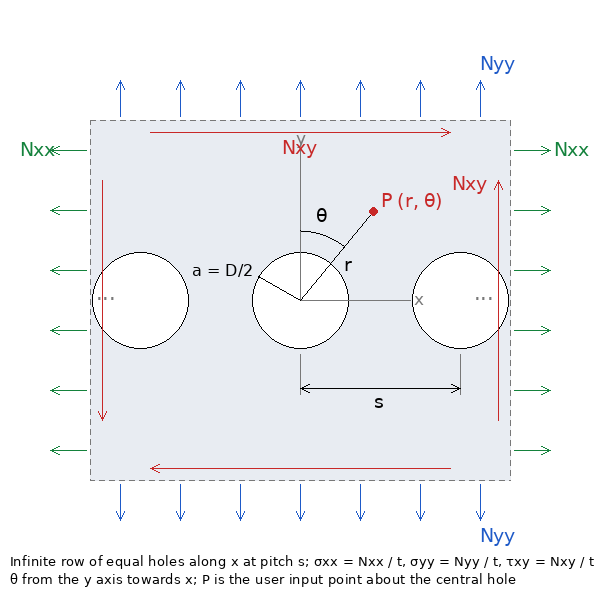
Figure A: Convention. The holes lie along x at the pitch s; θ is measured from the y axis towards x, the same convention as the other hole tools, so θ = ±90° are the points of the central hole facing its neighbors.
Key Assumptions
Infinite plate, infinite row of equal holes, linear elastic, plane stress, uniform far field. Every hole is traction-free and carries no resultant force, so the solution is periodic in x with the period s and does not depend on the elastic constants (it is the same in plane strain). The material stays elastic at the peak. The series is carried to convergence for 0 < D/s ≤ 0.9. A finite number of holes, a finite plate width or a second row (staggered or square lattice) are outside the tool.
Periodic Solution
With Muskhelishvili's potentials Φ(z) and Ψ(z) the stresses are σxx + σyy = 4 Re Φ and σyy − σxx + 2iτxy = 2[z̅ Φ′ + Ψ]. A single traction-free hole without a resultant force has the Laurent expansions Φ = Γ + ∑ αn z−n, Ψ = Γ′ + ∑ βn z−n (n ≥ 2; Kirsch's solution is the case n = 2, 4). By periodicity every hole of the row carries the same coefficients, and summing the single-hole terms over the hole centers ks (k = 0, ±1, ±2, …) gives, with the lattice sums Pn(z) = ∑k (z − ks)−n,
Φ(z) = Γ + ∑n αn Pn(z), z̅ Φ′ + Ψ = Γ′ + ∑n [ βn Pn(z) + 2i n y αn Pn+1(z) − n αn Pn(z) ].
The two extra terms come from writing the distance to each hole, z̅ − ks, as z̅ − z + (z − ks); they make the stress field periodic even though z̅ is not. All sums with n ≥ 2 converge absolutely and decay as exp(−2π|y|/s) away from the row, so Γ = (σxx∞ + σyy∞)/4 and Γ′ = (σyy∞ − σxx∞)/2 + iτxy∞ give the far field exactly. A uniform far field on a centrally symmetric row excites even n only; the normal loads give real coefficients and the shear load imaginary ones, so the two are solved separately and superposed. The coefficients are found by imposing σrr = τrθ = 0 at 3N + 60 points of the hole edge in a least-squares sense, with the order N chosen from D/s (8 at D/s = 0.1, 20 at 0.5, 104 at 0.9); the lattice sums are evaluated exactly, the nearest holes directly and the rest by the expansion ∑|k|>K (z − ks)−n = 2(−1)n ∑j C(n+j−1, j) zj s−n−j ζK(n+j) in truncated zeta functions. This is the construction of Horii and Nemat-Nasser (1985) and Isida and Igawa (1991) applied to the single row, and the problem first solved by Howland (1935) with periodic biharmonic functions.
Stress Concentration Factors
The hoop stress on the hole edge is scanned for its extremes. The gross factor Ktg = σmax/S1 is referred to the maximum far-field principal stress, as in the other general-load tools (S2 when S1 is not tensile). For a load across the row the ligaments of width s − D carry the load Nyy s per pitch, so the net-section stress is σn = σyy∞/(1 − D/s) and Ktn = σmax/σn; the tool also prints σyy midway between two holes, the lowest ligament stress. For a load along the row no load crosses the ligaments and only the gross factor is meaningful. The published charts (Peterson Charts 4.57–4.59) are reproduced by the fitted polynomials of Pilkey's tables, printed for comparison:
tension across the row (Schulz 1941): Ktn = 3.000 − 3.095λ + 0.309λ² + 0.786λ³,
tension along the row (Meijers 1967): Ktg = 3.0000 − 0.9916λ − 2.5899λ² + 2.2613λ³,
equal biaxial tension (Hütter 1942): Ktn = 2.000 − 1.597λ + 0.934λ² − 0.337λ³, λ = D/s.
Table 1 compares the converged series with these fits. The series agrees with the Schulz fit within 0.5 % up to λ = 0.7 and lies 2 to 3 % above it for the two closest spacings, where the original chart was drawn from a truncated solution. The Meijers fit matches at λ = 0.4 to 0.5 but drops too steeply from 3 near λ = 0: a first-order estimate with the neighbors' Kirsch fields summed over the row (ζ(2) = π²/6) gives 2.934 at λ = 0.1, confirming the series value 2.936 against the fit's 2.877. The Hütter fit is within 1 % up to λ = 0.4. The tool's values are the converged series.
| D/s | across: Ktg | across: Ktn | Schulz fit | along: Ktg | Meijers fit | biaxial: Ktn | Hütter fit |
|---|---|---|---|---|---|---|---|
| 0.1 | 3.000 | 2.700 | 2.694 | 2.936 | 2.877 | 1.830 | 1.850 |
| 0.2 | 3.006 | 2.405 | 2.400 | 2.768 | 2.716 | 1.704 | 1.715 |
| 0.3 | 3.031 | 2.122 | 2.121 | 2.547 | 2.531 | 1.605 | 1.596 |
| 0.4 | 3.096 | 1.858 | 1.862 | 2.326 | 2.334 | 1.516 | 1.489 |
| 0.5 | 3.241 | 1.621 | 1.628 | 2.139 | 2.139 | 1.427 | 1.393 |
| 0.6 | 3.546 | 1.419 | 1.424 | 1.995 | 1.961 | 1.335 | 1.305 |
| 0.7 | 4.204 | 1.261 | 1.255 | 1.887 | 1.813 | 1.241 | 1.224 |
| 0.8 | 5.755 | 1.151 | 1.124 | 1.802 | 1.707 | 1.151 | 1.148 |
| 0.9 | 10.706 | 1.071 | 1.038 | 1.733 | 1.658 | 1.071 | 1.073 |
Checks
The lattice sums were verified against a brute-force sum over 400,000 holes and against the closed form P2 = (π/s)² csc²(πz/s). The solved field is periodic in x to 10−16, returns to the far field as exp(−2πy/s), leaves a root-mean-square traction on the hole edge below 10−8 of the load (10−13 for D/s ≥ 0.5), and carries exactly σyy∞ s across each ligament (Gauss integration of σyy from the hole edge to mid-ligament). At D/s = 0.001 the factor is 3.000 (Kirsch) and the pure-shear factor is 4.0; the results do not change when the series order is doubled.
Limitations
The tool stops at D/s = 0.9 (ligament one ninth of the diameter), where the series needs about 100 terms and a page takes a few seconds. It does not cover a finite number of holes (two or three interacting holes, Peterson Charts 4.21–4.25, differ from the infinite row by several percent at close spacing), a finite plate width (Schulz's finite-width chart), staggered or square lattices (Meijers), or holes of unequal size. The hoop stress in Figure 1 is referred to the nearest hole center, so under a shear load the color field has a seam midway between the holes where the reference center changes.