Tools › Structures › Stress Concentrations › Rounded Square Hole › Method
Rounded Square Hole: Method
Open the Rounded Square Hole tool
Rounded Square Hole in an Infinite Plate under General In-plane Load
Problem Statement
A large, thin, flat plate contains a square hole of width W across the flats (half-width c = W/2) with corners rounded to a radius ρ, rotated by β from the position with sides parallel to the plate axes. Far from the hole the plate carries the uniform membrane state Nxx, Nyy, Nxy over the thickness t, so σxx∞ = Nxx/t and so on. The plate is linear elastic, isotropic, in plane stress and infinite. The question is the stress at a point P(r, θ), θ from the y axis towards x, and the extremes of the hoop stress on the hole edge, which for a square sit near the corners.
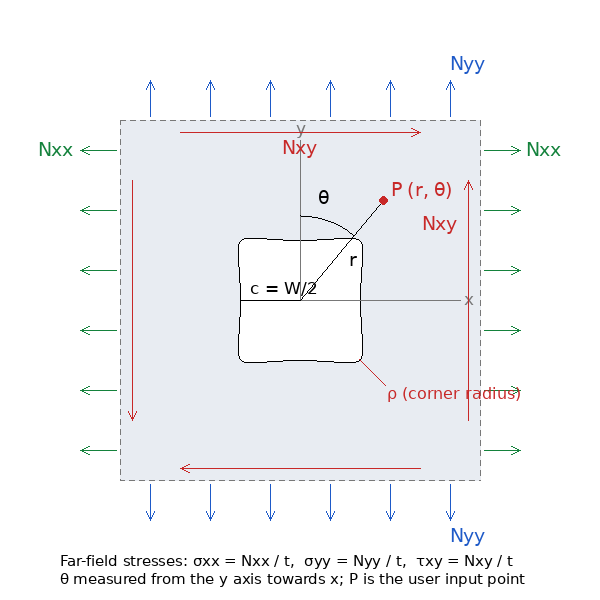
Figure A: Convention (β = 0 shown). Nxx, Nyy positive in tension; Nxy positive when it acts in +x on the top edge; c = W/2 is the half-width across the flats and ρ the corner radius; θ is measured from the y axis towards x.
Key Assumptions
Infinite plate, linear elastic, plane stress, uniform far field, open traction-free hole; one-term mapping of the square. The hole shape is Savin's rounded square, the image of a circle under z = R(ζ + m/ζ³). Its sides are not perfectly straight: they bulge outward by a small fraction of c (about 2 percent for Savin's square), and the corner radius is tied to m. The field for this shape is exact; the shape itself is the approximation. Only membrane resultants are handled; the material stays elastic at the peak.
The Mapping
The exterior of the unit circle |ζ| ≥ 1 is mapped onto the plate outside the hole by
z = ω(ζ) = R (ζ + m/ζ³), −1/3 < m < 0.
On the circle ζ = eit this traces a square with rounded corners whose sides are parallel to the axes: the midpoints of the sides are at R(1 + m) = c (map angles t = 0, 90°, …) and the corners on the diagonals at R(1 − m) (t = 45°, …). m = 0 is the circle; m = −1/6 is Savin's square, whose corner-to-center distance is 1.4 times the half-width, as for a true square; as m → −1/3 the corners become cusps. The corner radius is the radius of curvature of the mapped curve at t = 45°, computed from ω′ and ω″; it falls from c at m = 0 to 0.12c at m = −1/6 and to zero at the cusp. Given W and ρ the tool solves for m by bisection and sets R = c/(1 + m); it accepts ρ/c down to 0.02. The exact square would need the full Schwarz–Christoffel series ζ − ζ−3/6 + ζ−7/56 − ζ−11/176 + …; keeping one term is Savin's classical approximation.
Solution
For a remote tension S at angle α to the hole's x axis the Kolosov–Muskhelishvili potentials on this map are (derived for this tool by Muskhelishvili's Cauchy-integral method and checked as described below)
φ(ζ) = (SR/4) ζ + a1/ζ + a3/ζ³, a1 = (SR/2) [cos 2α/(1 − m) + i sin 2α/(1 + m)], a3 = −(SR/4) m
ψ(ζ) = −φ̄(1/ζ) − ω̄(1/ζ) φ′(ζ)/ω′(ζ), φ̄(1/ζ) = (SR/4)/ζ + ā1ζ + a3ζ³, ω̄(1/ζ) = R(1/ζ + mζ³)
φ comes from projecting the traction-free condition on the circle with the Cauchy integral: only the ζ−1 and ζ−3 terms survive, the ζ−3 coefficient being forced by the mζ−3 term of the map. ψ then follows from the boundary condition itself; the ζ³ terms that would grow at infinity cancel exactly because a3 = −SRm/4, and the surviving linear term equals −(S/2)e−2iαR, the correct remote state. With m = 0 the formulas are those of the round hole. The stresses are
σxx + σyy = 4 Re Φ, σyy − σxx + 2iτxy = 2 [z̄ Φ′ + ψ′] / ω′, Φ = φ′/ω′,
with the derivatives taken analytically. The general far-field state is handled as in the companion tools: it is resolved into S1, S2 and the direction of S1, the two uni-axial fields are evaluated in the hole's frame (load angle φ − β) and summed, and the tensor is rotated to the plate frame. For a point P the map is inverted by Newton's method on the quartic Rζ4 − zζ³ + Rm = 0, starting from ζ = z/R.
Checks built into the development: m = 0 reproduces the Kirsch stresses to all digits; on Savin's square the normal and shear stresses on the edge vanish to 10−13 at points on the sides, the corners and in between; the far field recovers the applied stress; a load along x at (x, y) equals a load along y at (y, x) with the components swapped (the square's symmetry).
Hole Edge and Stress Concentration Factor
On the free edge only the hoop stress remains, equal to σxx + σyy = 4 Re Φ there. The tool scans the edge (3600 points, refined by a golden-section search) and reports the largest and the most compressive value with the polar angle and radius of each point. For Savin's square (ρ/c = 0.12) under a single tension parallel to a side the peak is 3.86S, just off the corner on the side that faces the load, the hoop stress at the middle of that side is −0.81S, and at the middle of the side parallel to the load it is 1.48S; under equal biaxial tension the corners carry 6S. Sharper corners raise the peak roughly as (c/ρ)1/2. Rotating the square by 45° (a diamond, β = 45°) raises it a great deal: the corners on the axis across the load then act like the ends of a slender ellipse, and the tool gives 7.8S for Savin's proportions, close to Inglis's 1 + 2√(d/ρ) = 7.8 with d the corner distance, whereas the aligned square keeps its corners at 45° to the load where the hoop stress is milder.
Reference for Kt. As in the companion tools, Kt = σedge,max/S1, referred to the maximum far-field principal stress; when the far field has no tensile principal stress the ratios are formed with S2.
Reading the Plots
- σtt fringe. The tangential stress along the mapped curves |ζ| = constant, which are rounded squares shrinking onto the hole; on the edge it is the hoop stress. The color scale spans the two edge extremes in units of the reference stress.
- σmax fringe. The maximum principal stress; uniform S1 far from the hole, concentrated at the corners.
- Line plots. The hoop stress around the edge versus the polar angle of the edge point, and the plate-frame stresses along the line through the middle of a side and along a diagonal through a corner.
Limits
- Shape. The sides bulge slightly and the corner radius cannot go below about 2 percent of the half-width; for sharper corners or straight sides a multi-term map (Heller, Brock and Bart) or Sobey's charts are needed, and the values here will differ by a few percent from charts for the true rounded square.
- Rectangles need a different map (with a ζ−1 term as well); not handled here.
- Finite width, yielding and bending resultants: as for the companion tools.