Tools › Structures › Stress Concentrations › Rotating Disk With Hole › Method
Rotating Disk With Hole: Method
Open the Rotating Disk With Hole tool
Rotating Disk with a Central Hole
Problem Statement
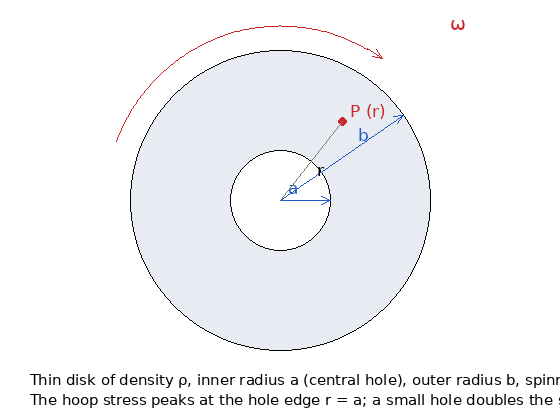
A thin uniform disk of density ρ, inner radius a and outer radius b spins at a constant angular speed ω. The centrifugal body force ρω²r is carried by radial and hoop stresses that depend only on r. Wanted are the stresses at a radius, the peak values and the growth of the bore and rim.
Key Assumptions
Thin disk (plane stress), uniform thickness and density, linear elastic, free bore and rim, constant speed. A hub press-fit or blade load on the rim adds a Lamé solution that superposes; a thick disk, a tapered profile or a thermal gradient are different problems.
Solution
With q = (3 + ν)ρω²/8 the equilibrium equation d(rσr)/dr − σθ + ρω²r² = 0 with compatibility gives
σr = q(a² + b² − a²b²/r² − r²), σθ = q[a² + b² + a²b²/r² − (1 + 3ν)r²/(3 + ν)],
which vanish in σr at r = a and r = b. The radial stress peaks at r = √(ab) with the value q(b − a)²; the hoop stress peaks at the bore, σθ(a) = (3 + ν)ρω²[b² + (1 − ν)a²/(3 + ν)]/4, where σr = 0, so the bore is in uni-axial hoop tension and the von Mises stress there equals the hoop stress. The radial growth is u = r(σθ − νσr)/E.
Stress Concentration of the Hole
A solid disk has its peak at the center, σ = qb², with equal radial and hoop stress. The hole doubles the hoop stress of the solid disk even when it is vanishingly small, and raises it further with size: K = σθ(a)/(qb²) = 2 + 2(1 − ν)(a/b)²/(3 + ν). This is the rotating-disk counterpart of the equal-biaxial Kirsch factor 2: at the center of a solid disk the stress state is equal biaxial, and a small hole there behaves as in a plate under equal biaxial tension.
Limits
- The disk must be thin compared with its radius; the plane-stress solution ignores the small axial stress of thick disks.
- Bursting speed: the bore yields first, at σθ(a) = Fty; the average hoop stress at burst is a separate (limit-load) calculation.