Tools › Structures › Stress Concentrations › Pressurized Hole › Method
Pressurized Hole: Method
Open the Pressurized Hole tool
Pressurized Round Hole under General In-plane Load
Problem Statement
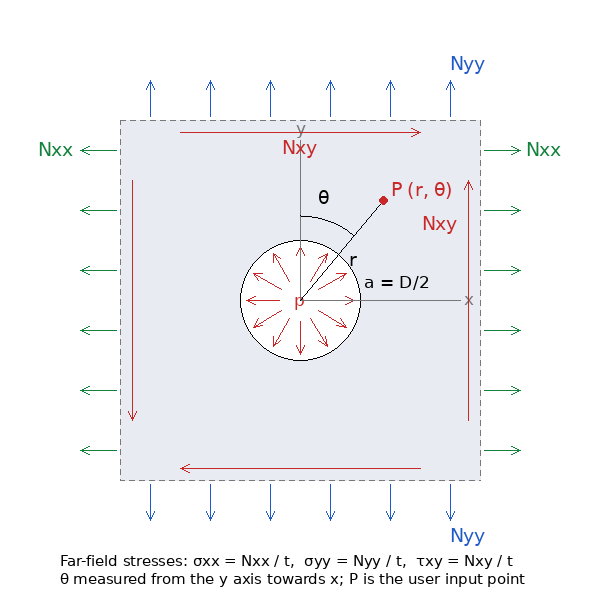
A round hole of radius a = D/2 in an infinite plate carries a uniform radial pressure p on its surface, from a fluid or from a press-fit pin or bushing, while the plate carries the uniform far-field state Nxx, Nyy, Nxy over the thickness t. Wanted are the combined stresses at a point, the hoop-stress extremes on the hole edge and the stress field.
Key Assumptions
Uniform pressure, infinite plate, linear elastic, plane stress. The pressure is the same all round the hole, as for a fluid or a well-fitted bushing; a pin that bears on one side of the hole (a loaded lug) produces a cosine-like bearing distribution and a resultant force, a different problem. The interference pressure formula takes the pin as rigid; an elastic pin reduces p.
Solution
The pressure alone gives the Lamé field, the thick-cylinder solution with the outer radius at infinity: σrr = −pa²/r², σθθ = +pa²/r², σrθ = 0. It is a pure shear state (σrr + σθθ = 0), carries no net load, decays as 1/r², and moves the hole edge outward by u = (1 + ν)pa/E in plane stress. A rigid pin of radial interference δ therefore produces p = Eδ/[(1 + ν)a]. The far-field state gives the general Kirsch field of the round-hole tool. Both are linear, so they add: on the edge the radial stress is −p, the shear vanishes and the hoop stress is the Kirsch edge value plus p, so its extremes are 3S1 − S2 + p on the S2 axis and 3S2 − S1 + p on the S1 axis. The pressure raises the hoop stress everywhere on the edge by the same amount, which is why a tight press fit lowers the fatigue life of a plate in tension less than one might expect at the sides (the mean stress rises but the range does not) while it can turn the compressive points at the load axis tensile.
Reference for Kt
With a far-field load present the factors are referred to the maximum far-field principal stress S1, as in the companion tools (so Kt = 3 − S2/S1 + p/S1); with pressure only they are referred to p (hoop stress = 1.0p all round).
Limits
- Pin bearing load (one-sided contact with a resultant) is not a uniform pressure; see Peterson's pin-loaded hole charts or a contact analysis.
- Elastic pin, finite width, yielding: not included.