Tools › Structures › Stress Concentrations › Pin-Loaded Hole › Method
Pin-Loaded Hole: Method
Pin-Loaded Round Hole in an Infinite Plate (Bickley's Series)
Problem Statement
An infinite thin plate of thickness t contains a round hole of diameter D (radius a) filled by a pin that pushes the plate in the +y direction with the load P. The pin bears on the half of the hole facing the load; the standard assumption for a fitted, frictionless pin is the cosine pressure p(θ) = p0 cos θ on |θ| < 90°, θ measured from the load axis, whose resultant πa t p0/2 equals P, so p0 = 4P/(πD t) = (4/π) σbr with the bearing stress σbr = P/(D t). The plate reacts the load far away. The questions are the stress at a point P(r, θ), the hoop stress around the edge (sides, crown and back) and the factor Kbr = σmax/σbr. An optional uniform bypass far field Nxx, Nyy, Nxy can be superposed for the loaded hole of a joint.
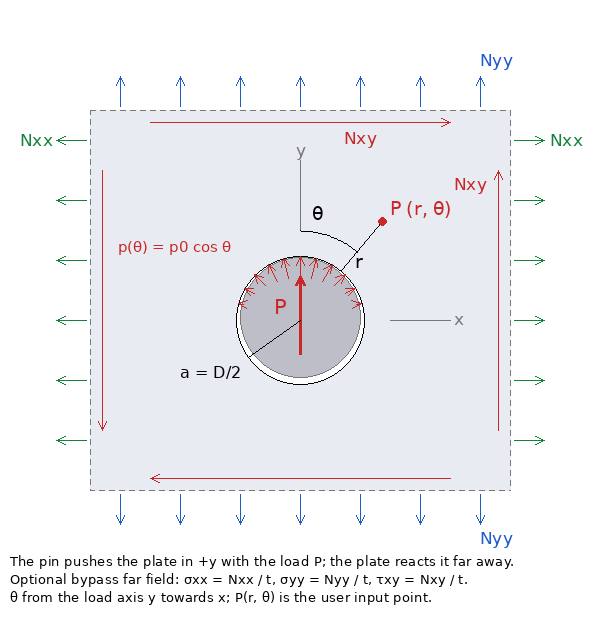
Figure A: Convention. The pin pushes towards +y; the pressure acts on the half |θ| < 90°, θ = ±90° are the sides and θ = 180° the back of the hole. The same θ convention as the other hole tools.
Key Assumptions
Infinite plate, linear elastic, plane stress or plane strain, frictionless fitted pin with a cosine pressure, load reacted at infinity. The pressure distribution is prescribed, not solved from contact: a rigid fitted pin gives nearly a cosine (de Jong 1977); clearance narrows the contact arc and raises the peak, interference widens it. Friction is neglected. An infinite plate has no net section, so the load is carried away by the 1/r point-force field; a lug or strip of finite width adds the net-section tension and gives far higher side stresses (Frocht and Hill 1940). The material stays elastic.
Bickley's Solution in Muskhelishvili Form
With the potentials Φ(z) and Ψ(z) the stresses are σxx + σyy = 4 Re Φ and σyy − σxx + 2iτxy = 2[z̅ Φ′ + Ψ]. A hole whose edge tractions have the resultant X = P/t (load along the solver's x axis) needs the logarithmic terms of Muskhelishvili,
Φ(z) = A/z + ∑k≥2 Pk (a/z)k, Ψ(z) = B/z + ∑m≥2 Qm (a/z)m, A = −X/(2π(1 + κ)), B = κX/(2π(1 + κ)),
with κ = (3 − ν)/(1 + ν) in plane stress and 3 − 4ν in plane strain. The terms A/z, B/z alone are Timoshenko's force at a point of an infinite plate, σrr = −(3 + ν) X cos θ/(4πr). On the edge r = a the condition σrr − iσrθ = Φ + Φ̅ − e2iθ(z̅Φ′ + Ψ) with σrr = −p(θ), σrθ = 0 is matched mode by mode after expanding the pressure, p(θ)/p0 = 1/π + ½ cos θ + (2/π) ∑j≥1 (−1)j+1 cos 2jθ/(4j² − 1):
Q2 = p0/π, Q3 = (A + B)/a, Pk = −p0 fk/2, Qk+2 = k Pk (k ≥ 2),
while the cos θ mode of the pressure is carried entirely by the force terms, A − B = −X/(2π) = −p0a/4, which is the statement that the resultant of the pressure is P. Only the force terms depend on ν; the hoop stress at the sides does not. The series converges as 1/k² on the edge (the pressure has a slope discontinuity at ±90°) and geometrically away from it; the tool keeps 1200 terms, which fixes the side value to four digits. The bypass field is Kirsch's solution for the uniform far-field state, added by superposition (the general-load round-hole tool).
Results for the Pin Load Alone
In units of the bearing stress σbr = P/(D t), plane stress, ν = 0.3:
| point | θ | σθθ/σbr, ν = 0 | ν = 0.3 | ν = 0.5 |
|---|---|---|---|---|
| sides | ±90° | 0.810 | 0.810 | 0.810 |
| crown (under the peak pressure) | 0 | 0.492 | 0.397 | 0.333 |
| back | 180° | −0.144 | −0.049 | 0.015 |
The sides carry the largest hoop stress, 0.81 σbr for any ν; the crown is in tension because the pressure pushes the plate apart sideways (the radial stress there is −p0 = −1.27 σbr), and the back is nearly unstressed. These are far below the factors of a lug because an infinite plate has no net section; with a bypass tension across the load axis the Kirsch field adds 3 σyy∞ at the sides.
Checks
NASA TP-1862 (Crews, Hong and Raju 1981, Figure 3) quotes Bickley's cosine-pressure solution for the infinite isotropic sheet as Ktb = 0.81, which the tool reproduces (0.810). The same report solves the pin contact instead of assuming it: a rigid frictionless pin touches over 83° rather than 90° and the finite-element factor is 0.87, with the contact solutions of Eshwar et al. and de Jong at 0.92 and 0.91. The cosine assumption therefore underestimates the side stress of a snug rigid pin by about 7 to 12 %; it remains the standard closed-form idealization. The series reproduces the prescribed edge tractions (radial stress −p(θ) to 2 × 10⁻⁵ σbr, shear to 10−15); the resultant of the tractions on a circle of radius 3a or 30a equals −P/t to seven digits (equilibrium); at 200a the field is Timoshenko's point force within the 1/r² terms; the side value converges as 0.8066, 0.8086, 0.8096, 0.8101 for 100, 200, 400, 800 terms. A uniform pressure over the half circle was tried and rejected: its jump at ±90° makes the hoop stress there logarithmically singular, so no finite peak exists.
Limitations
The pressure shape is assumed, not solved from the contact of a pin with clearance, interference or friction; the pin is rigid and the plate is isotropic (de Jong 1977 gives the orthotropic case); the plate is infinite, so finite-width lugs and edge distances (Peterson Chart 4.64, Frocht and Hill) are outside the tool. The bypass superposition is linear elastic and ignores the change of contact arc that the bypass load causes.