Tools › Structures › Stress Concentrations › Neuber Hyperbolic Notch › Method
Neuber Hyperbolic Notch: Method
Open the Neuber Hyperbolic Notch tool
Neuber Hyperbolic Notch Stress Concentration
Problem Statement
A bar is weakened by notches whose flanks are hyperbolas: a flat bar of thickness h with two symmetric notches leaving a net width d, or a round bar with a circumferential groove leaving a net diameter d. The root radius is ρ. The bar carries an axial force P, a bending moment M and, for the round bar, a torque T. Wanted are the elastic stress concentration factors referred to the nominal stress on the net section and the peak stresses at the notch root.
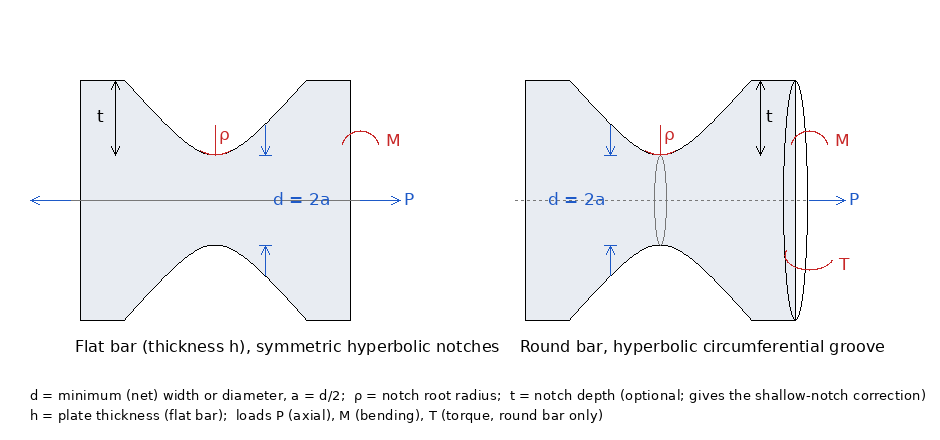
Figure A: The two members. d is the minimum section, a = d/2, ρ the root radius, t the notch depth; h is the flat bar's thickness.
Key Assumptions
Linear elastic, hyperbolic flanks, net-section nominal stress. Neuber's deep-notch solutions are exact for notch flanks that are hyperbolas running out to their asymptotes, which fixes the flank half-angle at atan√(ρ/a); a V-notch with another flank angle, or a notch whose flanks end at a finite depth, is covered only approximately by the interpolation. The flat bar is a plane problem (plane stress or plane strain give the same in-plane stresses); the round bar is axisymmetric and its tension and bending factors depend on Poisson's ratio. The peak stress is elastic: when it exceeds yield, use Neuber's rule or the Linear to True Stress/Strain tool.
Neuber's Method
Neuber (1937) solved the plane and axisymmetric problems in curvilinear coordinates in which the notch flank is a coordinate line: elliptic coordinates make the hyperbolic notch a line v = constant, and the stress function separates. The deep-notch solutions follow for a bar whose section is bounded only by the two hyperbolas (the depth is infinite). With x = a/ρ the factors, referred to the nominal stress on the net section, are
flat bar, tension: K = 2(x + 1)√x / [(x + 1) atan√x + √x]
flat bar, in-plane bending: K = 4x√x / {3[√x + (x − 1) atan√x]}
round bar, tension: K = [x√(x+1) + (½ + ν)x + (1 + ν)(√(x+1) + 1)] / [x + 2ν√(x+1) + 2]
round bar, bending: K = ¾(√(x+1) + 1)[3x − (1 − 2ν)√(x+1) + 4 + ν] / [3(x + 1) + (1 + 4ν)√(x+1) + (1 + ν)/(1 + √(x+1))]
round bar, torsion: K = 3(1 + √(x+1))² / [4(1 + 2√(x+1))]
All tend to 1 as a/ρ → 0 (a gentle neck), except the round bar in tension, which tends to (1.5 + 2ν)/(1 + 3ν) because a slender neck between wide shoulders is triaxially constrained; for large a/ρ they grow as √(a/ρ) with the coefficients 4/π and 8/(3π) for the flat bar in tension and bending and 1 and 3/8 for the round bar in tension and torsion. The five expressions were checked against the tabulation in Noda, Takase and Monda (1996).
Notches of Finite Depth
A real notch has a depth t. If it is shallow compared with the net section, the stress field near the root is that of an elliptic notch in a half-plane, Ks = 1 + 2√(t/ρ) in tension and bending and 1 + √(t/ρ) in torsion. If it is deep, the ligament governs and the deep-notch solution applies. Neuber bridged the two with
1/(KN − 1)m = 1/(Ks − 1)m + 1/(Kd − 1)m, m = 2,
which returns the smaller of the two factors when they differ widely and lies below both when they are close. Noda, Takase and Monda compared it with body-force-method results for V-notched bars and found m = 2.8 fits within 5–7 percent (and give polynomial correction factors for 1 percent); the tool reports both exponents and uses Neuber's m = 2 for the peak stresses. When no depth is entered the deep-notch values stand alone.
Nominal and Peak Stresses
Nominal stresses are taken on the net section: P/(dh) and 6M/(d²h) for the flat bar; 4P/(πd²), 32M/(πd³) and 16T/(πd³) for the round bar. Each is multiplied by its factor; the axial and bending peaks add on the tension side of the root, the torsional shear acts with them, and for the round bar a von Mises equivalent is formed at the free surface of the root (the hoop stress along the groove, of order ν times the axial peak, is neglected).
Limits
- Flank angle. Hyperbolic flanks only; a 60° V-notch with a small root radius behaves much like the hyperbolic notch of the same a/ρ, but the correspondence is not exact (Peterson's charts give the V-notch values).
- Single notch, U-notch, shoulder fillet. Different problems; Neuber's book and Peterson give their factors.
- Fatigue. Kt is the elastic factor; the fatigue notch factor is smaller for small radii (notch sensitivity).