Tools › Structures › Stress Concentrations › Hole in Plate Bending › Method
Hole in Plate Bending: Method
Open the Hole in Plate Bending tool
Round Hole in a Thin Plate under Bending
Problem Statement
A thin plate of thickness t with a round hole of radius a = D/2 carries uniform remote bending moments per unit width Mxx, Myy and a twisting moment Mxy. Wanted are the moments and surface stresses at a point, and the concentration of the bending stress at the hole edge.
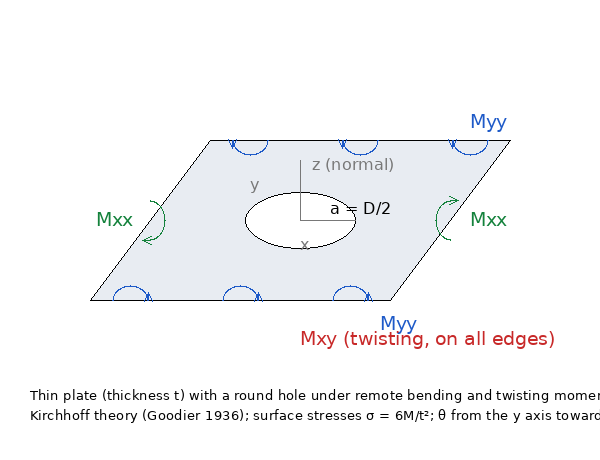
Key Assumptions
Kirchhoff thin-plate theory, infinite plate, free hole edge, linear elastic. Transverse shear deformation is neglected, which holds for D/t above about 5; for smaller holes Reissner's theory gives a larger factor, approaching 3. Surface stresses are 6M/t²; the mid-plane is unstressed, so membrane loads (the companion tools) add linearly on each face.
Solution
For a single remote moment M on the faces normal to x, the far-field deflection is w0 = −M(x² − νy²)/[2D(1 − ν²)], D the flexural rigidity. The hole adds the biharmonic terms ln r, r−2cos 2θ and cos 2θ, whose coefficients follow from the two Kirchhoff free-edge conditions at r = a: Mr = 0 and the effective shear Vr = Qr + (1/r)∂Mrθ/∂θ = 0 (the twisting moment itself need not vanish). The result, with q = a²/r² and θ from the moment's x axis:
Mr = (M/2)(1 − q) + (M/2)[1 − 4νq/(3 + ν) − 3(1 − ν)q²/(3 + ν)] cos 2θ
Mθ = (M/2)(1 + q) + (M/2)[−1 − 4q/(3 + ν) + 3(1 − ν)q²/(3 + ν)] cos 2θ
Mrθ = −(M/2)[1 − 2(1 − ν)q/(3 + ν) + 3(1 − ν)q²/(3 + ν)] sin 2θ
On the edge Mr = 0 and Mθ = M[1 − 2(1 + ν)/(3 + ν) cos 2θ], largest at θ = 90°: K = (5 + 3ν)/(3 + ν), Goodier's factor (1.79 for ν = 0.3), and (1 − ν)/(3 + ν) at θ = 0. The membrane counterpart is 3 and −1: in bending the hole disturbs the plate much less, because the free edge can shed its moment through the Kirchhoff shear and both faces share the curvature. Equal biaxial bending gives Mθ = 2M all round, the same as the membrane case. A general state is the superposition over the two principal moments.
Checks built into the development: the derived field satisfies Mr = 0 and Vr = 0 on the edge to 10−9 (the shear condition evaluated by finite differences of the moments), recovers the far-field moments, reproduces Goodier's factor, and the superposition equals the single-moment field.
Limits
- Thick plates (D/t < 5): Reissner theory, Peterson's charts.
- Elliptic holes in bending: Goodier (1936) also; not implemented.
- Combined membrane and bending: add the surface stresses of this tool to those of the membrane tools on each face.