Tools › Structures › Stress Concentrations › Elliptic Hole General Load › Method
Elliptic Hole General Load: Method
Open the Elliptic Hole General Load tool
Elliptic Hole in an Infinite Plate under General In-plane Load
Problem Statement
A large, thin, flat plate with an elliptic hole (semi-axes a and b, a inclined by β from the x axis) carries a uniform in-plane membrane state far from the hole, given as the stress resultants Nxx, Nyy, Nxy and the thickness t: σxx∞ = Nxx/t, σyy∞ = Nyy/t, τxy∞ = Nxy/t. The plate is linear elastic, isotropic, in plane stress and infinite. The question is the stress at a point P(r, θ), θ from the y axis towards x, and the hoop-stress extremes on the hole edge.
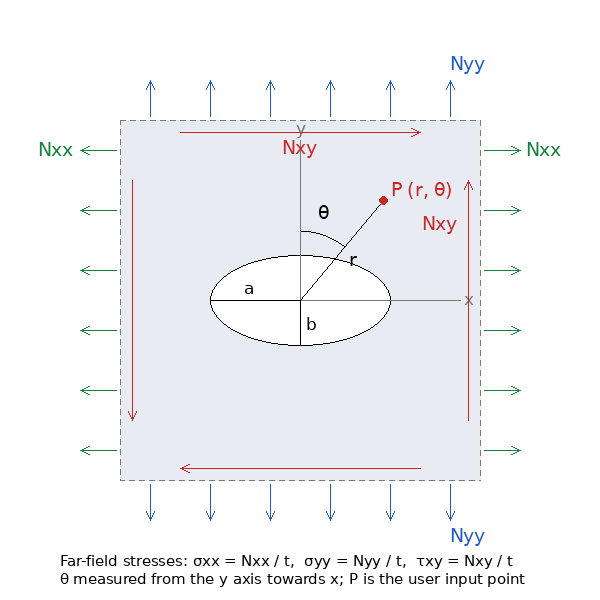
Figure A: Convention (β = 0 shown). Nxx and Nyy positive in tension; Nxy positive when it acts in +x on the top edge; β rotates a counterclockwise from x; θ is measured from the y axis towards x.
Key Assumptions
Infinite plate, linear elastic, plane stress, uniform far field, open traction-free hole. Only membrane resultants are handled; bending moments are a different problem. The material stays elastic at the peak. The solution does not depend on the elastic constants.
Solution by Superposition
The far-field state is resolved into its principal values S1 ≥ S2 and the direction φ of S1. The Inglis solution is linear, so the field is the sum of the uni-axial fields for S1 at φ and S2 at φ + 90°. Each is evaluated with the Kolosov–Muskhelishvili potentials of the uni-axial elliptic tool on the map z = R(ζ + m/ζ), R = (a + b)/2, m = (a − b)/(a + b), with the load angle in the hole's frame α = φ − β:
φ(ζ) = (SR/4) [ζ + A/ζ], A = 2e2iα − m; ψ(ζ) = −(SR/4) [1/ζ + Āζ] − (SR/4) (1 + mζ²)(ζ² − A) / [ζ(ζ² − m)]
σxx + σyy = 4 Re Φ, σyy − σxx + 2iτxy = 2 [z̄ Φ′ + ψ′] / ω′, Φ = φ′/ω′.
The two fields are summed in the hole's frame and the tensor is rotated to the plate frame. The result is exact: the only arithmetic is complex algebra. With a = b it reproduces the general Kirsch field of the round-hole tool.
Hole Edge and Stress Concentration Factor
On the free edge only the hoop stress remains, equal to σxx + σyy = 4 Re Φ there. For an aligned ellipse under a single tension S along y it is (1 + 2a/b)S at the ends of a and −S at the ends of b; under equal biaxial tension 2(a/b)S at the ends of a and 2(b/a)S at the ends of b; for a round hole 3S1 − S2 and 3S2 − S1. In general (any a/b, β, S2/S1) the extremes leave the axis ends, so the tool evaluates the hoop stress around the whole edge (3600 points, refined by a golden-section search) and reports the largest and most compressive values with the polar angle of each.
Reference for Kt. There is no single applied stress, so Kt = σedge,max/S1, referred to the maximum far-field principal stress (uni-axial aligned: 1 + 2a/b; round hole in pure shear: 4). When the far field has no tensile principal stress the ratios are formed with S2.
Principal Stresses at the Probed Point
From σxx, σyy, τxy at P the tool gives the polar components about the hole center, σmax, σmin, τmax, and the direction of σmax from the y axis (φx) and from the radial direction (φp), each within ±90°.
Reading the Plots
- σηη fringe. The tangential stress along the confocal ellipses, the hoop stress on the edge; the color scale spans the two edge extremes in units of the reference stress.
- σmax fringe. The maximum principal stress; uniform S1 far from the hole.
- Line plots. The hoop stress around the edge versus the polar angle of the edge point, and the plate-frame stresses along the hole's own a and b axes.
Limits
- Finite width, yielding and very slender holes (a/b above about 20): as for the uni-axial tool.
- Bending resultants are not handled.