Tools › Structures › Stress Concentrations › Circular Inclusion › Method
Circular Inclusion: Method
Open the Circular Inclusion tool
Circular Inclusion in an Infinite Plate under General In-plane Load
Problem Statement
A large, thin, flat plate (the matrix, modulus E1, Poisson's ratio ν1) contains a circular inclusion of diameter D made of another material (E2, ν2), perfectly bonded along the interface. Far from the inclusion the plate carries the uniform membrane state Nxx, Nyy, Nxy over the thickness t. Wanted are the stress inside the inclusion, the stress at a point P(r, θ) in either region, and the interface stresses that govern matrix cracking (hoop), debonding (radial) and interface slip (shear). A rigid plug and an empty hole are the two limits.
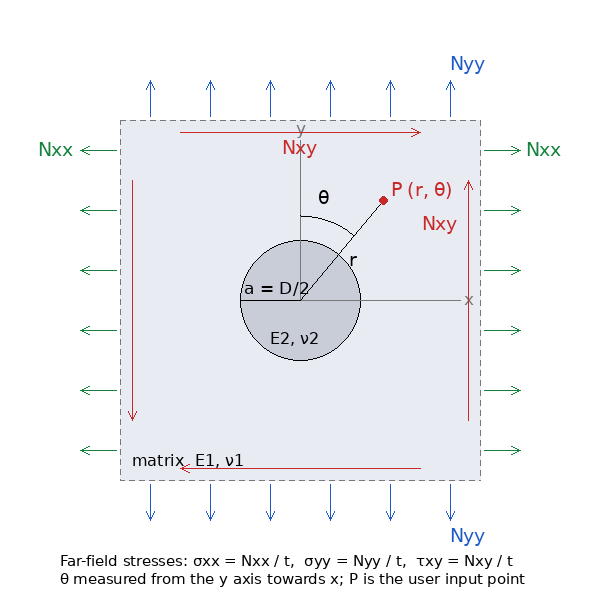
Figure A: Convention. Nxx, Nyy positive in tension; Nxy positive when it acts in +x on the top edge; θ is measured from the y axis towards x; the shaded disc is the inclusion.
Key Assumptions
Infinite plate, linear elastic isotropic materials, perfect bonding, plane stress or plane strain. No slip and no separation at the interface (the tool reports the radial and shear interface stresses so that the bond can be checked), no interference fit or thermal mismatch (those add a Lamé pressure that superposes), uniform far field. Plane stress uses κ = (3 − ν)/(1 + ν), plane strain κ = 3 − 4ν.
Solution
With the Kolosov–Muskhelishvili potentials the far field is φ → Γz, ψ → Γ′z, where Γ = (σxx∞ + σyy∞)/4 is real and Γ′ = [(σyy∞ − σxx∞) + 2iτxy∞]/2 carries the deviatoric part. The disturbance of a circle is described by the same powers of z as in Kirsch's problem, so
matrix (r ≥ a): φ1 = Γz + Aa²/z, ψ1 = Γ′z + Ba²/z + Aa4/z³
inclusion (r ≤ a): φ2 = Dz, ψ2 = Fz, a uniform state: σxx + σyy = 4D, σyy − σxx + 2iτxy = 2F.
Continuity of traction, φ + zφ̄′ + ψ̄, and of displacement, (κφ − zφ̄′ − ψ̄)/2μ, on |z| = a gives, power by power in z,
A = Γ̄′ (μ2 − μ1)/(κ1μ2 + μ1), F = Γ′ μ2(1 + κ1)/(κ1μ2 + μ1), D = μ2(κ1 + 1)Γ / [2μ2 + μ1(κ2 − 1)], B = 2D − 2Γ.
The deviatoric and hydrostatic parts decouple: the inclusion sees the far-field mean stress multiplied by fh = μ2(κ1 + 1)/[2μ2 + μ1(κ2 − 1)] and the far-field deviator multiplied by fd = μ2(1 + κ1)/(κ1μ2 + μ1). A matched inclusion gives fh = fd = 1 and A = B = 0 (no disturbance); a rigid one gives (κ1 + 1)/2 and (1 + κ1)/κ1; an empty hole gives 0 and the Kirsch potentials φ = Γz − Γ̄′a²/z, ψ = Γ′z − 2Γa²/z − Γ̄′a4/z³. The stresses follow from σxx + σyy = 4 Re φ′ and σyy − σxx + 2iτxy = 2(z̄φ″ + ψ′). The matrix field is exact and closed-form; no mapping or inversion is needed.
Checks built into the development: with E2 = 0 the field equals the general Kirsch field of the round-hole tool to all digits; with matched materials the field is the far field everywhere; for an elastic inclusion the radial and shear stresses and both displacement components are continuous across the interface to ten digits while the hoop stress jumps; for a rigid inclusion the matrix displacement on the interface is zero; the far field is recovered.
Interface Stresses and Concentration Factors
A stiff inclusion attracts load: the radial stress at the interface on the load axis exceeds the far-field stress (about 1.5S for a rigid plug in plane stress under uni-axial tension, the classical Goodier value), and this radial stress is what tries to separate a bonded plug from the plate; the interface shear peaks at 45°. A soft inclusion sheds load: the matrix hoop stress at the sides rises towards the Kirsch value of 3S as E2 → 0. The tool scans the interface on the matrix side and reports the hoop, radial and shear extremes with their angles, and refers them to the maximum far-field principal stress S1: Khoop for matrix cracking, Krad for debonding, and KI = σmax,inclusion/S1 for the inclusion itself. For the empty hole Khoop = 3 − S2/S1.
Reading the Plots
- σθθ and σmax fringes. Both regions are colored; inside the inclusion the state is uniform, so σmax is constant there while σθθ, a polar component of a uniform state, varies with the angle. The color scale spans the extreme stresses of the problem.
- Interface plot. Radial and shear stresses are continuous across the bond; the hoop stress is drawn for both sides.
- Axis plots. The stresses along the x and y axes from the center outward, uniform inside the inclusion and jumping in the tangential component at r/a = 1.
Limits
- Imperfect bonding (slip, partial debonding) and interference or thermal fit are not included; an interference pressure p adds the Lamé solution (radial −p, hoop +p at the matrix interface) and can be superposed by hand.
- Finite width and yielding: as for the hole tools.
- Three-dimensional inclusions (spheres, fibers loaded along their axis) and elliptic inclusions (Hardiman) are different problems.